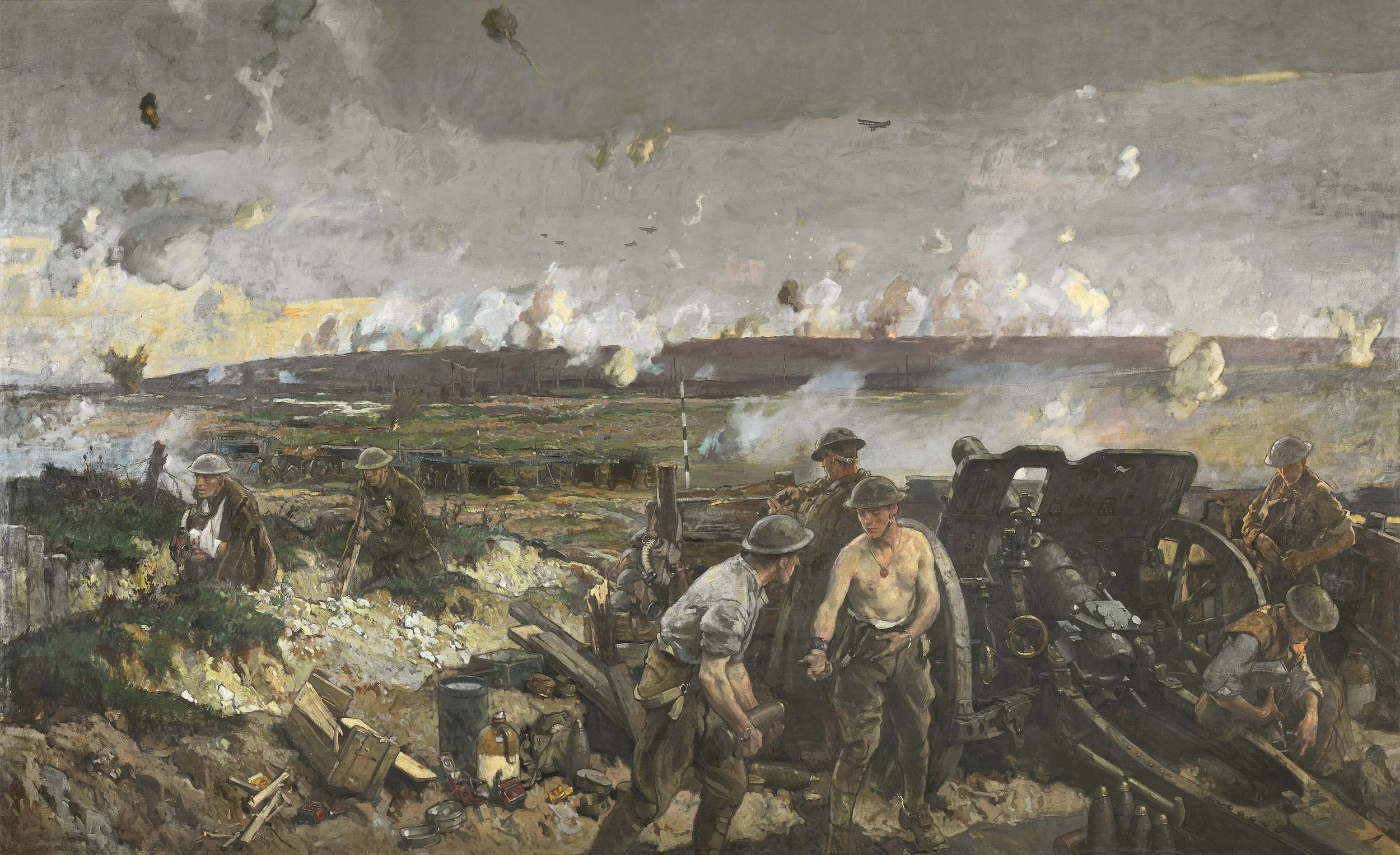
The Taking of Vimy Ridge, Easter Monday, 1917, by Richard Jack (Canadian War Museum)
Reviewing A Soldier’s Diary: The WWI Diary of Donald Macpherson (2001)
Diaries, letters, and memoirs all provide different reading experiences and varied perspectives. And although this blog series is titled “Great War Memoirs,” I’ll review different formats from time to time. The diaries of Donald Stuart Macpherson, published in 2001 by a minor press, Vanwell, in Ontario, but available to borrow on Open Library where I accessed it, presents some of the most trying, but also most rewarding aspects of the type.
Donald Macpherson (1895-1991) was one of five brothers from Orangeville, Ontario, to serve with Canadian forces in World War I. His diary commences in March 1916 with his enlistment, and concludes in March 1919 with his return home and discharge. In 1965, he transcribed the diary as a gift for his children to remind them of the patriotism, devotion to duty, and sacrifice of Donald and his brothers. As published in 2001, it includes photos of Donald and his brothers, along with images of some of the diary pages.
Donald, who had to undergo an unspecified medical operation to make him fit for enlistment, served initially as a signaler with the 9th Battery, Canadian Field Artillery, a position which involved significant frontline service in liaison duty between the battery and the front, as he underwent his baptism of fire at Vimy Ridge in April 1917 and then in the Ypres Salient. In the course of this duty he received the Military Medal. In the winter of 1917-1918, Donald went to England for training and commissioning as a junior officer, only to be severely wounded on his first day back in combat at Amiens on August 8, 1918.
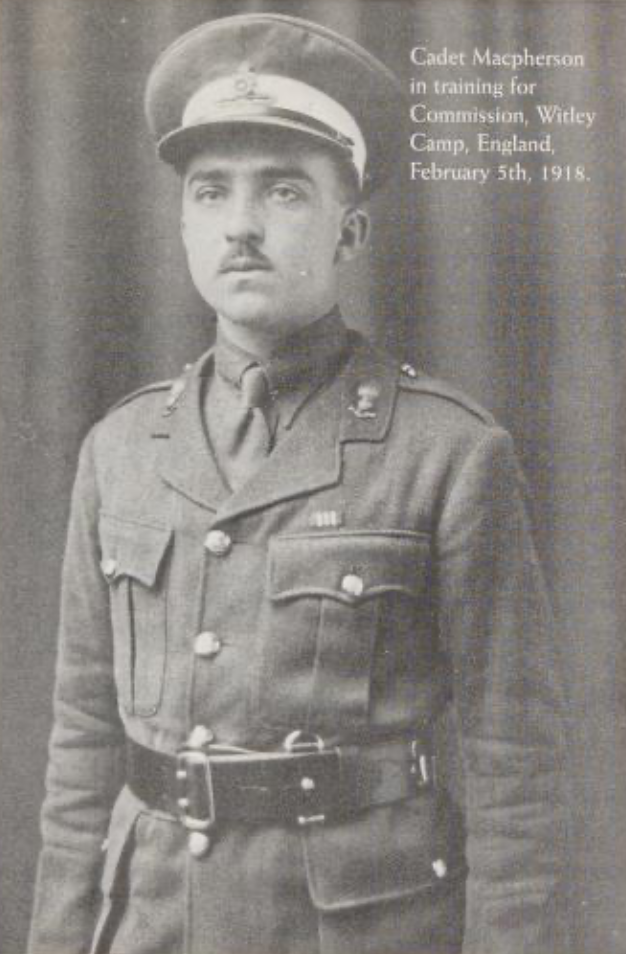
Image from A Soldier’s Diary
Transformed by War
Reading an unedited war diary requires some patience. Much of Macpherson’s diary chronicles rear-area duties and recreation, efforts to visit his brothers at the front, explorations of French and British towns and countryside, and so on. Reading the 200-page diary nevertheless provides a window into the Macpherson’s personal transformation in the crucible of war. Early in this 200-page diary, twenty-one-year-old Donald is fresh, patriotic, devout, and more than a little naive about the war and his place in it. By the end, he’s still patriotic and devout, but deeply matured, and, between the lines but nevertheless palpably, seared by his experiences.
At Vimy and Ypres, Donald came under heavy artillery and machine-gun fire on numerous occasions, and once was in a column bombed by German Gotha aircraft; men were killed next to him, but he survived without physical injury. His descriptions of Vimy and other engagements are interesting, if circumscribed by his personal viewing point. He was a little stunned to be decorated, and even more so to be put forward for a commission. Ironically, the fact that Macpherson spent nine months out of action, training for his commission and then restlessly idle despite the Canadian Expeditionary Force’s increasingly desperate manpower and officer shortages in 1917-1918 is revealing of the bureaucratic problems that bedeviled Canadian (and other) forces through the war.
Donald Macpherson was very severely wounded on August 8, 1918, at Amiens, incurring wounds in the head and torso that, at age twenty-three, would leave him permanently physically impaired. More devastating was the news of the death of his older brother Ross, a highly decorated officer with Princess Patricia’s Canadian Light Infantry, while Ross was in the hospital trying to recuperate. Afterwards, reading Donald’s diary, it’s clear that some life spark has been extinguished, never to return.
My Goodreads rating: four out of five stars.