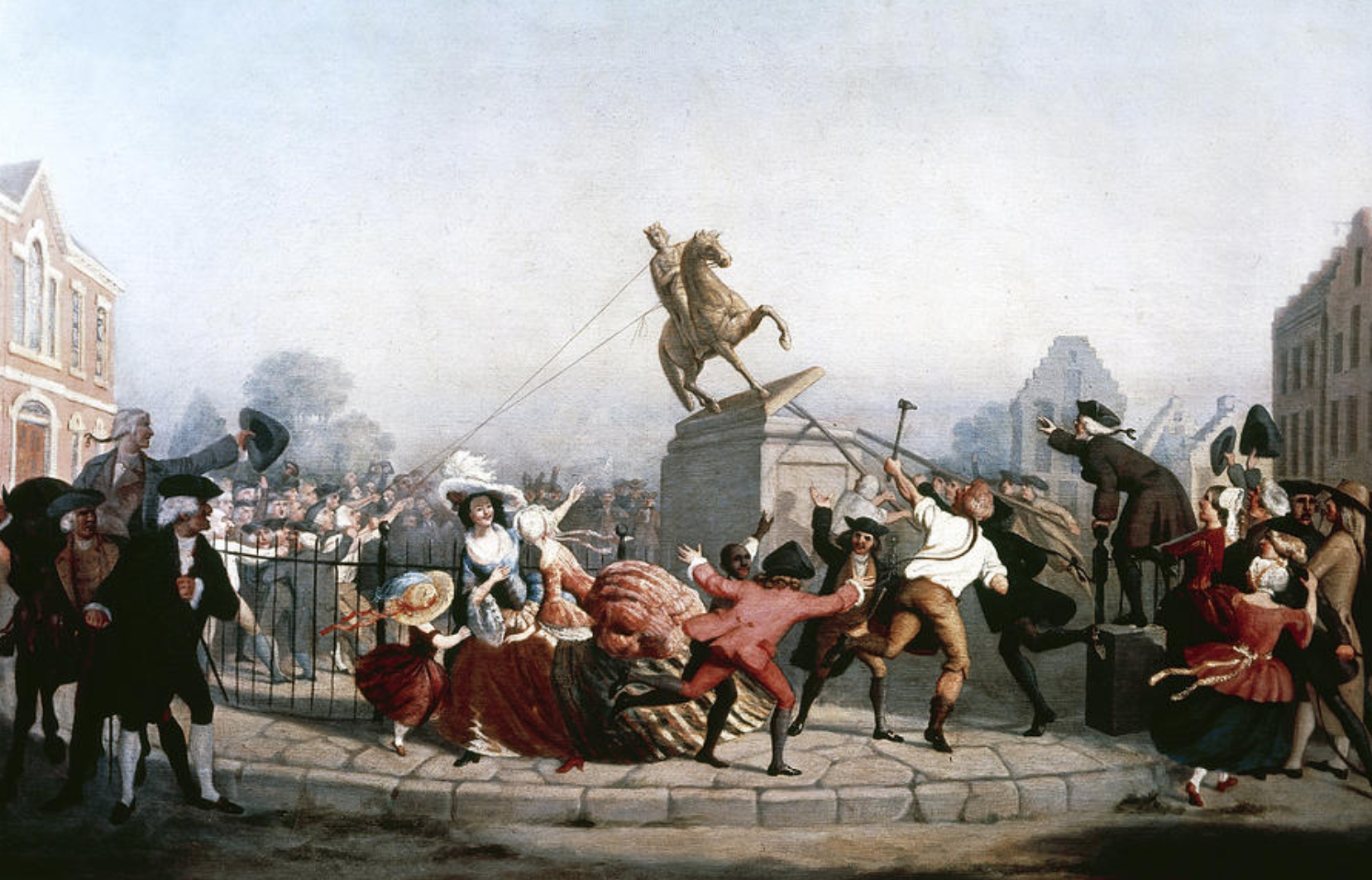
Pulling Down the Statue of George III, by William Walcutt (1854, Wikimedia Commons)
The Continental Congress voted in favor of the Declaration of Independence on July 2, dating it July 4. Whether or not he knew about it, Washington paid no heed; as commander-in-chief, he believed, politics was not his concern. Instead, with the British fleet off New York City growing by the day, and British redcoats swarming across Staten Island, Washington focused on the military matters at hand. General Nathanael Greene was dispatched to Long Island, from where this efficient officer provides accurate intelligence on the origins and composition of the British fleet and amphibious force.
Washington also dismissed the New Jersey militia under his command, allowing the militiamen to go defend their homes. At the same time, he urged New Jersey governor William Livingston to capture and confine any known loyalists: “all Persons,” Washington said, “of known Enmity or doubtful Character should be removed from Places where they might enter into a Correspondence with the Enemy & aid them in their Schemes.” Now was not the time, Washington insisted, for misplaced civility toward the disaffected: “my Tenderness has been often abused & I have had Reason to repent the Indulgence shewn them. I would shew them all possible Humanity & Kindness consistent with our own Safety—but Matters are now too far advanced to sacrifice any Thing to Punctilio.”
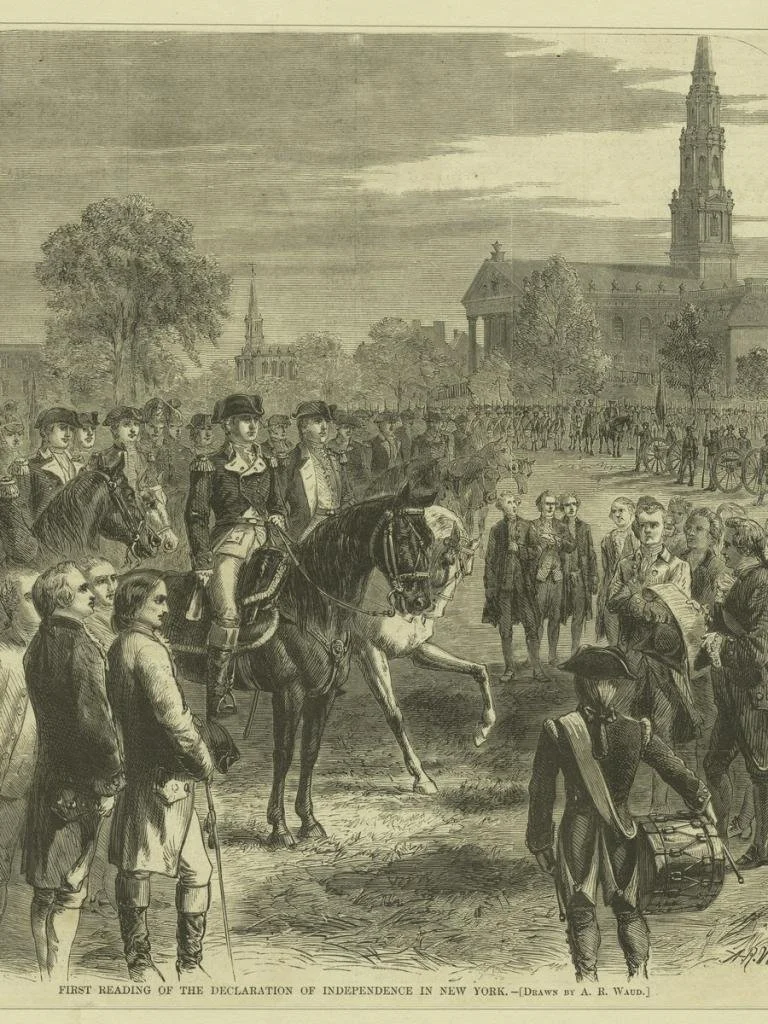
Reading the Declaration of Independence (Wikimedia Commons)
Reading the Declaration of Independence
On July 6, Continental Congress President John Hancock informed Washington formally of the vote to declare independence. “The Congress,” Hancock wrote, “for some Time past, have had their Attention occupied by one of the most interesting and important Subjects, that could possibly come before them, or any other Assembly of Men.
“Altho it is not possible to foresee the Consequences of Human Actions, yet it is nevertheless a Duty we owe ourselves and Posterity, in all our public Counsels, to decide in the best Manner we are able, and to leave the Event to that Being who controuls both Causes and Events to bring about his own Determinations.
“Impressed with this Sentiment, and at the same Time fully convinced, that our Affairs may take a more favourable Turn, the Congress have judged it necessary to dissolve the Connection between Great Britain and the American Colonies, and to declare them free & independent States; as you will perceive by the enclosed Declaration, which I am directed to transmit to you, and to request you will have it proclaimed at the Head of the Army in the Way, you shall think most proper.”
On July 9, Washington declared to his army in General Orders: “The Honorable the Continental Congress, impelled by the dictates of duty, policy and necessity, having been pleased to dissolve the Connection which subsisted between this Country, and Great Britain, and to declare the United Colonies of North America, free and independent STATES: The several brigades are to be drawn up this evening on their respective Parades, at six OClock, when the declaration of Congress, shewing the grounds & reasons of this measure, is to be read with an audible voice.
“The General hopes this important Event will serve as a fresh incentive to every officer, and soldier, to act with Fidelity and Courage, as knowing that now the peace and safety of his Country depends (under God) solely on the success of our arms: And that he is now in the service of a State, possessed of sufficient power to reward his merit, and advance him to the highest Honors of a free Country.” Thrilled at this powerful expression of their cause, the troops broke out in three hearty huzzahs.
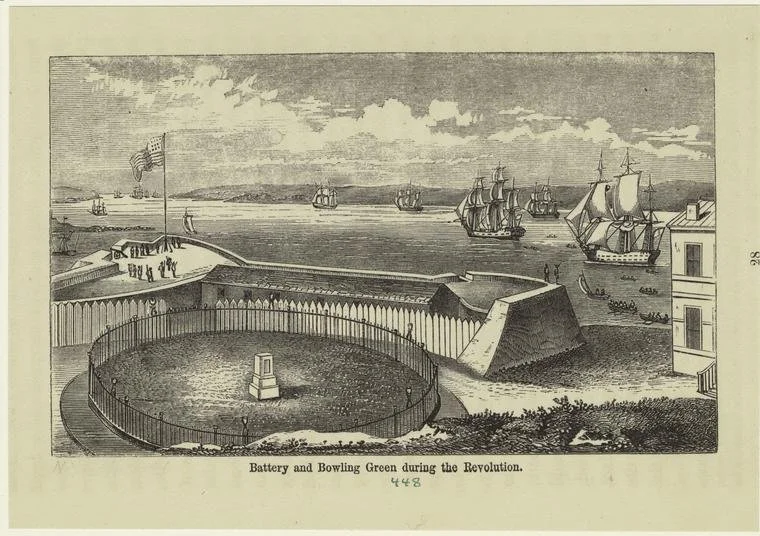
The Empty Pedestal at the Bowling Green (Wikimedia Commons)
A Toppled Statue Points Toward Blood and Slaughter
Huzzahs were well and good, but Washington did not approve of what came next. That evening a crowd of soldiers assembled without orders and surged down to New York’s Bowling Green at the end of Broadway, where stood a statue of King George III, appearing like a Roman emperor. Garlanding it with ropes, the troops pulled down the lead statue and beheaded it.
Washington, always a stickler for order and proper authority sternly disapproved, telling his troops the next morning that. “Tho the General doubts not the persons, who pulled down and mutilated the Statue, in the Broadway, last night, were actuated by Zeal in the public cause; yet it has so much the appearance of riot and want of order, in the Army, that he disapproves the manner, and directs that in future these things shall be avoided by the Soldiery, and left to be executed by proper authority.”
Afterwards, Washington sat down to write Hancock about the Declaration of Independence. His tone was deeply formal: “I perceive that Congress have been employed in deliberating on measures of the most Interesting nature. It is certain that It is not with us to determine in many Instances what consequences will flow from our Counsels, but yet It behoves us to adopt such, as under the smiles of a Gracious & All kind Providence will be most likely to promote our happiness; I trust the late decisive part they have taken is calculated for that end, and will secure us that freedom and those privileges which have been and are refused us, contrary to the voice of nature and the British Constitution. Agreable to the request of Congress I caused the Declaration to be proclaimed before all the Army under my Immediate command and have the pleasure to inform them that the measure seemed to have their most hearty assent, The expressions and behavior both of Officers and men testifying their warmest approbation of It.”
Speaking of the task ahead, Washington added that, “If our Troops will behave well, which I hope will be the case, having every thing to contend for that Freemen hold dear, [the enemy] will have to wade through much blood & Slaughter before they can carry any part of our Works, If they carry ’em at all, and at best be in possession of a melancholy and mournfull victory. May the sacredness of our cause Inspire our Soldiery with sentiments of Heroism, and lead ’em to the performance of the noblest exploits.”
Much blood and slaughter would indeed ensue, in the near future.