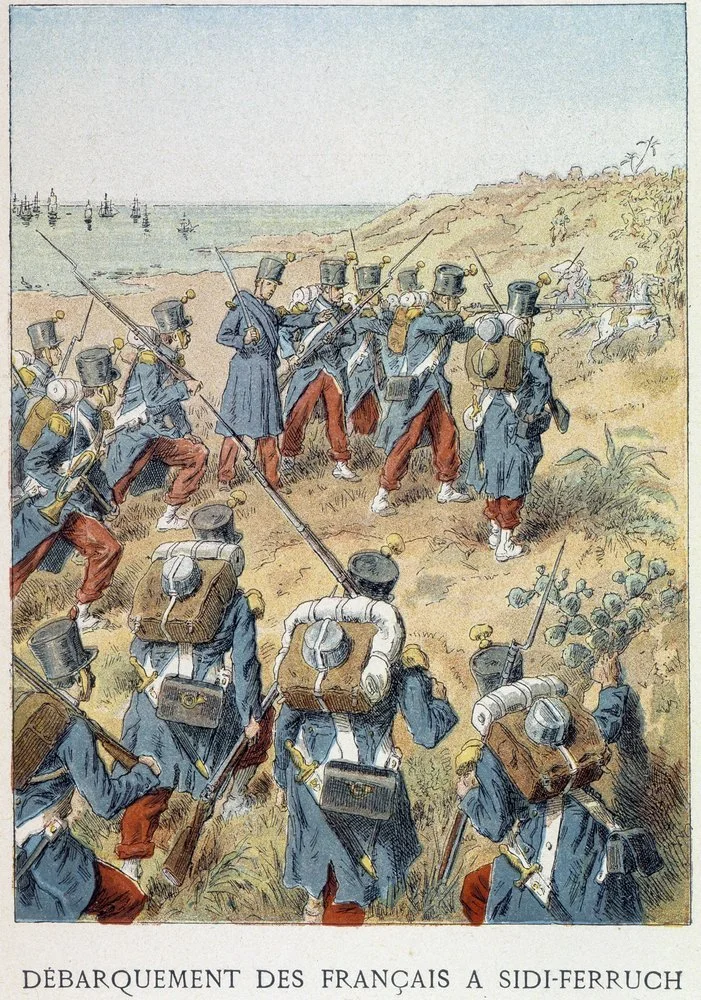
Henriette de Witte, Conquête de l’Algérie par le France Débarquement de Sidi-Ferruch (1897, Wikimedia Commons).
The French Invasion Assembles Under a Hated Commander
Three years on from the Fly Whisk Incident that sparked war between France and the Regency of Algiers, the fighting had amounted to little more than a few naval skirmishes off western North Africa, accompanying a porous French naval blockade. King Charles X of France, the last of the ruling Bourbon dynasty (though he didn’t know it yet), facing a restive population at home, decided with his loyal ministers that an amphibious invasion of Algeria, surely to be followed quickly by victory with the capture of Algiers, was just the thing to distract his people from political affairs and rally them around the white flag of the Bourbon monarchy.
The invasion fleet, consisting of hundreds of warships and merchant vessels, assembled in Toulon and Marseilles in the spring of 1830. The lad force would be huge by the standards of the time: just over 37,600 troops, mostly infantry, with field and siege artillery, just a small cavalry contingent, engineers, and well-stocked commissary (including ample supplies of wine!), hospital, and other support detachments.
The king’s choice to command the expedition, Louis-Auguste-Victor, Comte de Bourmont, was controversial to put it mildly. In fact, almost everyone, whatever his political views, hated Bourmont. Though he had always been a Bourbon loyalist, Bourmont had made his peace with the Emperor Napoleon at the height of his powers, only to betray him during the Hundred Days in 1815, switching sides just before the Battle of Waterloo. “A cur,” quipped Prussian General Blucher at the time, “remained a cur, whatever color he wore.”
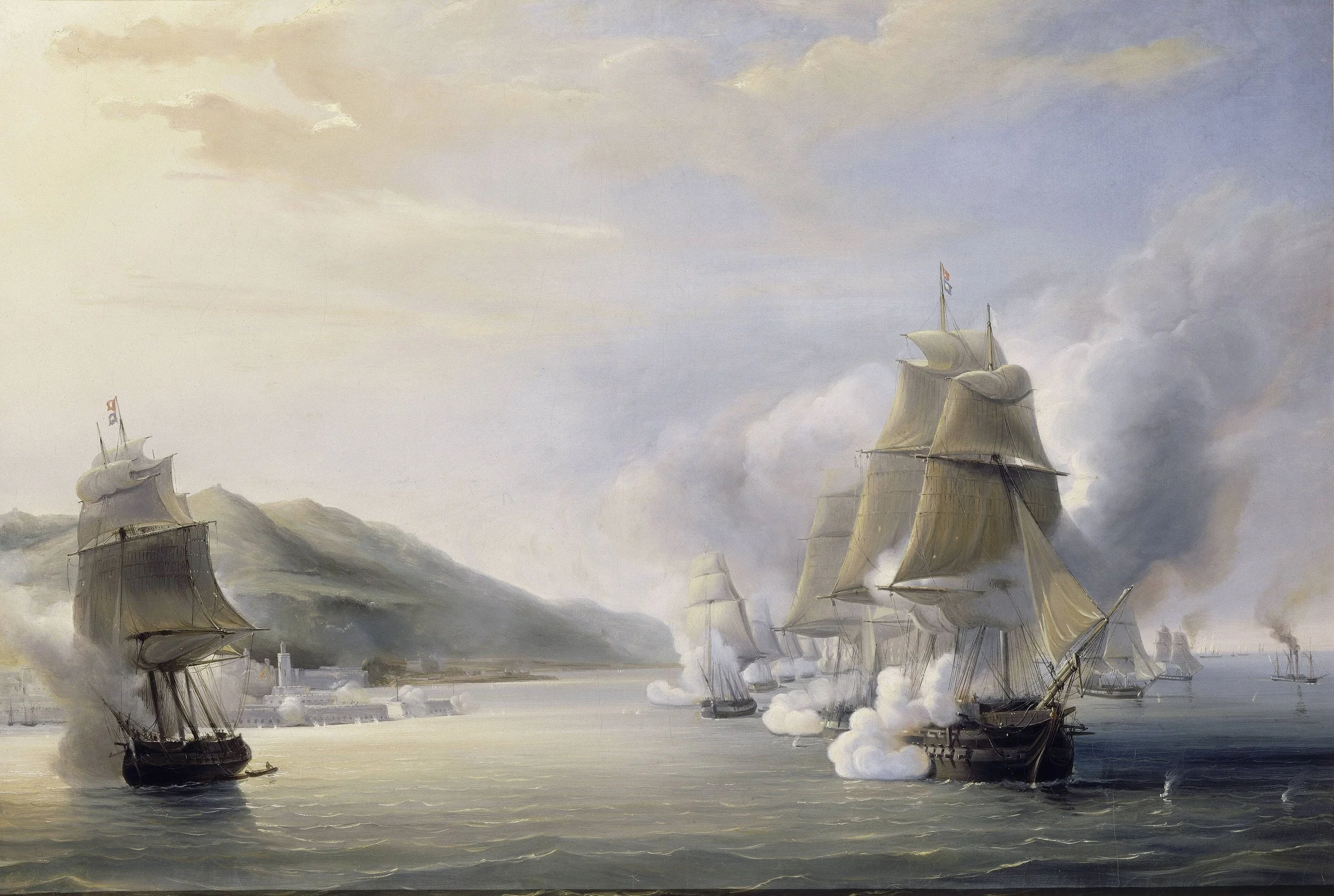
Bombardement d’Alger, 1830, by Antoine Léon Morel-Fatio (Wikimedia Commons)
Landing at Sidi-Ferruch, June 14, 1830
Weather pummeled the French invasion fleet as it crossed the Mediterranean Sea. A young medical student, Jean-Pierre Bonnafont, taking passage on a warship to serve the hospital detachment, was nevertheless thrilled to take part in such a historical event. The beauty of the ships as they assembled off Algiers on June 11, 1830, overwhelmed him with the “magical spectacle” of hundreds of ships hoisting signal lanterns upon their masts to aid assembly for imminent landing. The next morning the coastline came within sight, and the doctor praised another view: hundreds of ships unfurling their sails simultaneously to dry the canvas under the rising sun’s rays. He could not help contemplating that this “ravishing sight” would soon be gone forever as the age of sail gave way to that of steam power.
The landing began in the early morning hours of June 14, as specially designed landing barges carried troops and supplies ashore at Sidi-Ferruch, a sandy spit west of Algiers. Arab horsemen appeared onshore, waving muskets and taking potshots, but not contesting the landing. Bourmont knew, however, that the Day of Algiers had tasked his son-in-law, Ibrahim, with assembling an army with Turkish Janissary troops, other infantry, Arab auxiliaries and ample artillery, to attack the French and throw them back into the sea.
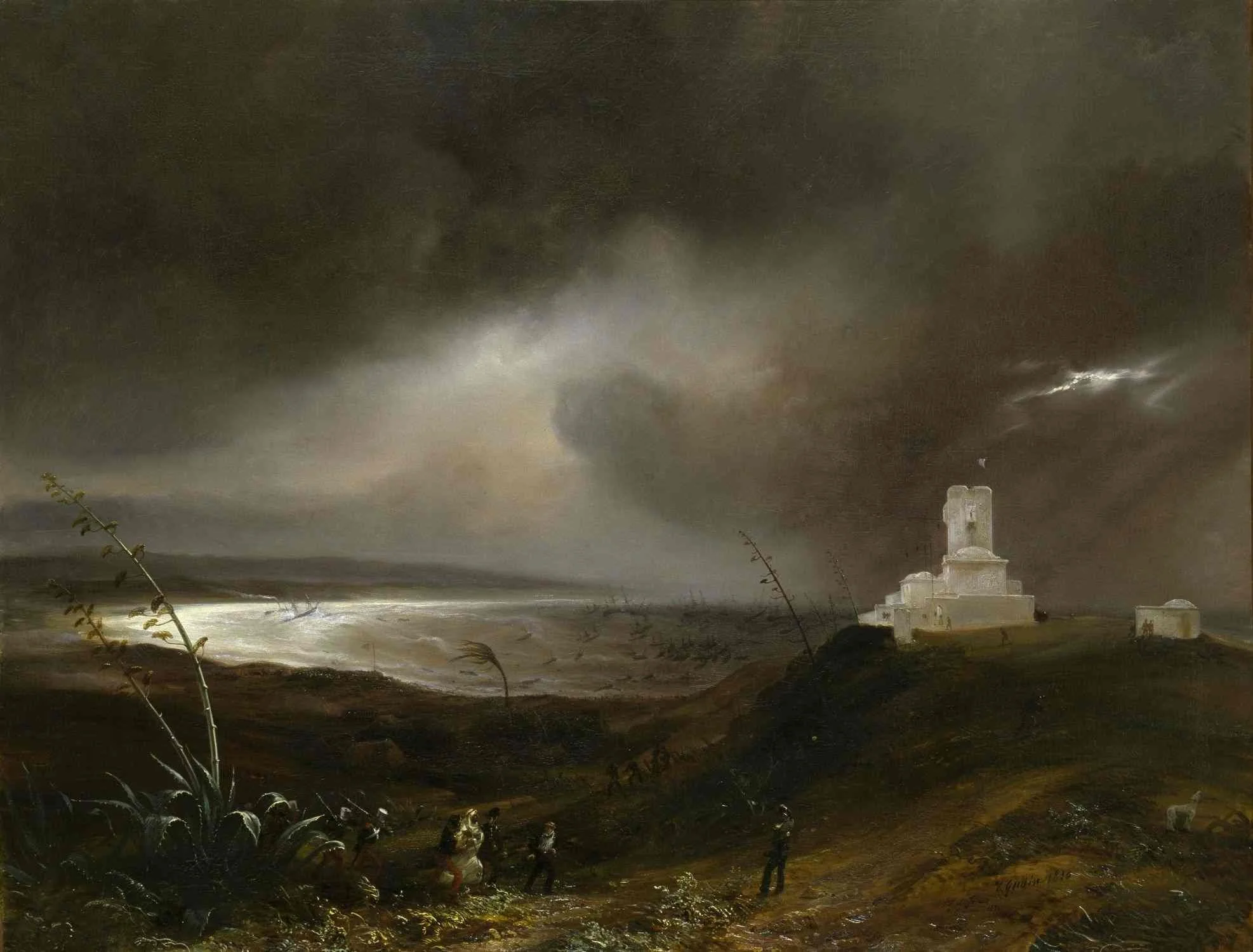
Coup de Vent du 16 Juin 1830 a Sidi-Ferruch, by Theodore Gudin (Wikimedia Commons)
Cannon, and Mother Nature, Contest the Invasion
Ibrahim’s artillerymen abandoned a shore battery near a white marabout’s tomb (depicted in the painting above), but batteries of heavy artillery just inland quickly took the French infantry under fire. Bourmont, splendidly attired in his uniform and determined to show himself at the head of his troops, imprudently mounted a sand dune and, surrounded by his large retinue, lifted a spy glass to observe the enemy. Moments later a huge Turkish cannonball landed at his feet, showering the general with sand. Bourmont remained still, brushed himself off, and walked quietly away, hoping that a display of sang-froid would impress his officers and men.
It didn’t—they still loathed him.
Oblivious, Bourmont ordered the one of his three divisions of infantry to move against the unsupported enemy batteries, and in a series of deft movements the French outflanked and captured them before they could be removed to safety. This done, Bourmont oversaw the landing’s completion, organizing and deploying his troops for the move inland. Two days later, however, a heavy storm offshore (depicted above) pounded and scattered the French fleet, isolating the army ashore. Unused to North Africa and mostly neophytes to combat, French soldiers trembled for fear of what would happen to them if they remained isolated. They had already heard of how Algerians treated European captives.
Worse, Ibrahim had assembled his army a short distance away, ready to strike. The first major battle of the French wars of conquest in North Africa, depicted in my upcoming book Lions of the Atlas and in upcoming blog posts, was about to commence.