Defiance Sparks Imperial War: Unleashing the Lions of the Atlas
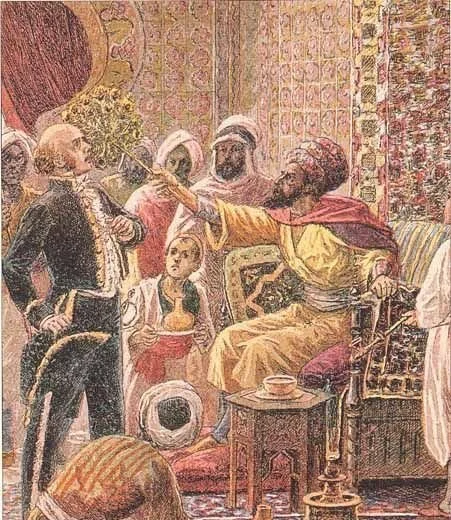
Le Coup d’Eventail 1827 (Wikimedia Commons)
A Swat of the Fly Whisk
France’s centurylong campaign for the conquest of the Maghreb—western North Africa including Morocco, Algeria, and Tunisia—began with seemingly the most trivial of incidents.
Pierre Deval was a sixty-eight-year-old, faithful flunky of France’s Bourbon monarchy, restored to power after Napoleon’s defeat in 1815 and, twelve years later, sputtering toward extinction under the last Bourbon King, Charles X. Serving as consul to the Regency of Algiers, Deval had to mediate between his own royal master and the Dey of Algiers, Hussein, nominally loyal to the Ottoman Empire’s sultan but really ruling a semi-independent entity roughly contiguous with modern Algeria.
King and Dey had a disagreement, a minor matter regarding old Napoleonic Wars debts. Charles X, however, thought that communicating directly with the Dey was beneath him. Refusing to respond to Hussein’s letters directly, the king instead referred them to subordinates like Deval.
In an audience in Algiers on April 30, 1827, the Dey finally had enough. Fixing his stormy gaze on Deval, the ruler shouted: “Am I some sort of a bumpkin, a ragbag or a scrounger? Why didn’t I get an answer? You are a mere scoundrel, infidel and idolater!” With a wave of his arm, the Dey ordered Deval out of his sight. But the Frenchman prevaricated, upon which the Dey stepped up and slapped Deval three times in the face with his fly whisk. Reddening, the consul withdrew.
Deval would get his own back, even if it meant war. Furious, he wrote to Charles X claiming that the Dey hadn’t just insulted the consul, but the king, and therefore France itself. Charles X agreed. The French government cracked down, this time addressing the Dey: he must apologize abjectly, and raise the French flag over Algiers. Of course, Hussein refused, and on June 15, 1827, France declared war on the regency.
Charles X had other motives. Punishing Algiers, he thought, would give him credibility with the restive French people. As the minister of war said, “a legitimate monarchy . . . also knows how to float its battle flags in far-off countries.” The king also considered himself to be acting on the behalf of all of Europe against North African slave traders and pirates.
So began a conflict that would see some of the most remarkable battles and campaigns in history. In subsequent blog posts, and in my new book to be released this fall, we’ll trace the footsteps of the Lions of the Atlas who changed the face of warfare.