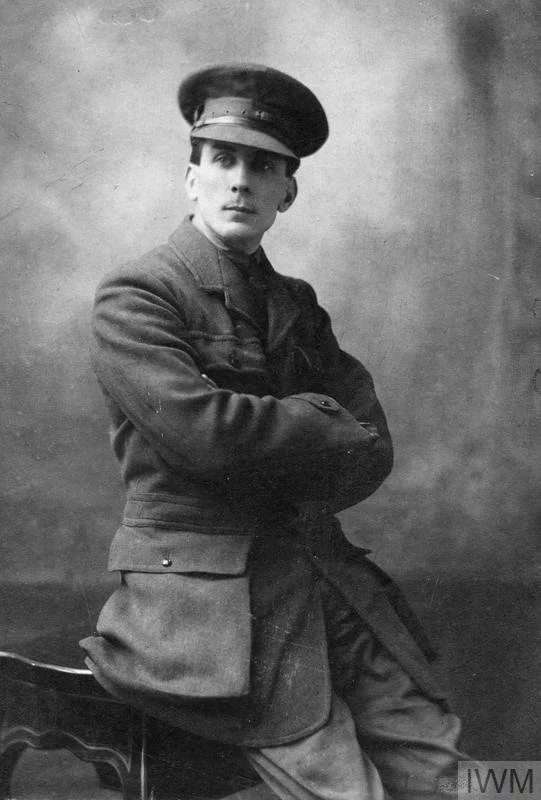
Wartime portrait of Geoffrey Malins (Imperial War Museums)
Reviewing How I Filmed the War: A Record of the Extraordinary Experiences of the Man Who Filmed the Great Somme Battles (1920)
Geoffrey Malins (1886-1940) was a bit of a lunatic. It’s hard to avoid that conclusion, anyway, when reading his memoir, How I Filmed the War. This is the second memoir I’ve read to commemorate the Battle of the Somme, which began 110 years ago on July 1, 1916, by hearing the people who were there.
Everyone familiar with the Western Front in World War I knows about—or should, anyway—the groundbreaking films, The Battle of the Somme, and The Battle of the Ancre and the Advance of the Tanks, released to the British public in theaters at the war’s height. I acquired VHS copies of these movies during my first visit to London’s Imperial War Museum in 1990, and later used them when I was a graduate student to teach undergraduates about war’s impact on society (my Ph.D. is in British and Irish history, in case you were wondering!)
To the modern viewer, these films may seem tedious, with their lengthy images of men and supplies moving to the front, and artillery firing, with only brief glimpses of artillery shells exploding in the distance or men in the trenches (although these short glimpses are still impactful). During the war, however, civilian audiences were overwhelmed by watching these in theaters; there were reports of parents and loved ones breaking down sobbing during screenings, and avidly scanning the faces of soldiers, hoping against hope that their boys would appear—as sometimes they did. Millions flocked to see the movies. Director Peter Jackson brilliantly used some of this footage, with interviews, colorization, and added sounds and voices, in his 2018 film, They Shall Not Grow Old.
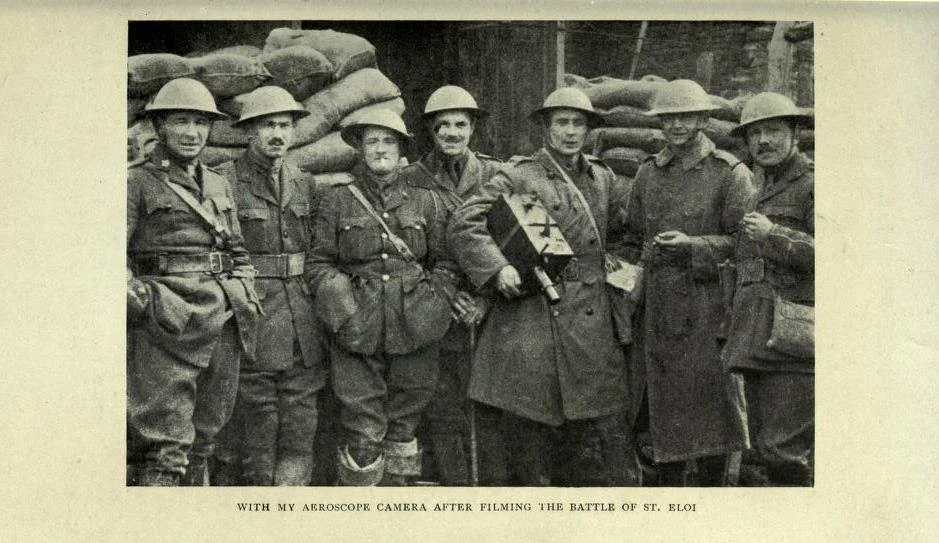
Malins with camera in the spring of 1916, from How I Filmed the War
The Madman Behind the Camera
I keep calling Malins a kook, but I mean that in an affectionate way. How I Filmed the War is a tornado of a memoir, written breathlessly as he describes, first, his early experiences filming the Belgian Army in Flanders, and the French in the Vosges in the autumn of 1914 as a cameraman for the Gaumont Film Company. Next, Malins describes his appointment in 1915 as the War Office’s official “kinematographer” to record the British Army in action leading up to and beyond the Somme. Clutching his huge box camera and other equipment, including tripod and reels of film strapped under his greatcoat, the lanky Malins was wont to rush off to the front on his own, sometimes getting in trouble with military authorities, in order to catch glimpses of the action. He was absolutely indomitable, placing his camera in positions and angles that had never been attempted before, including just behind the parapets of front-line trenches as attacks went in, or during artillery bombardments. Malins also took to the air over Ypres in a BE2c to film trenches from above.
Clearly, Malins was prone to more than a little pomposity and exaggeration. Reading his memoir, including his filming of the bombardment and beginning of the Somme offensive near Beaumont Hamel, leaves the impression that he spent practically every moment at the front dodging shells and bullets meant specifically for him, landing just feet away or perforating his cap, in an endless series of last-second escapes. Some of his shots have been exposed as probably staged, in particular one of British infantry assaulting into the mist, crossing barbed wire, and taking casualties (reading between the lines of his account of July 1, 1916, I think he did witness the attack, but had run down his first reel of film on the mine explosion at Beaumont Hamel, causing him to miss the moment of assault and leading him to fill it in with staged footage later on; readers who know better will doubtless correct me).
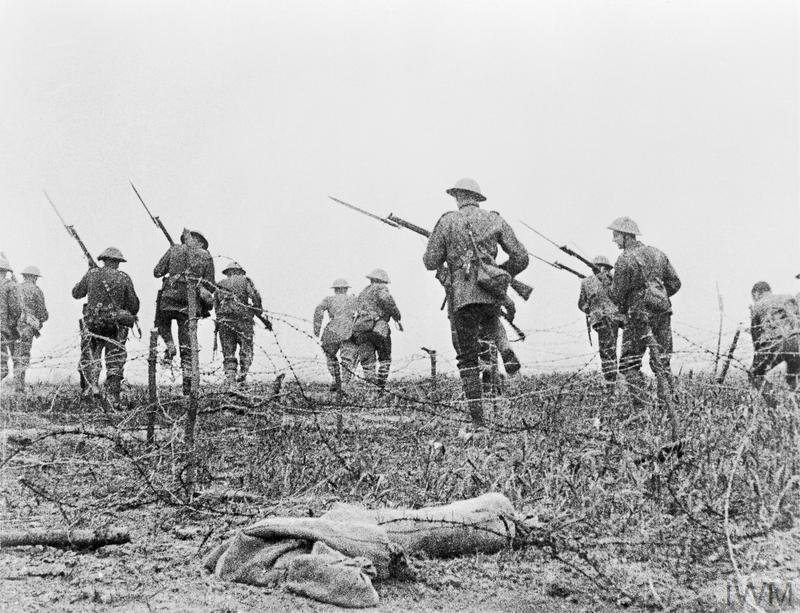
A still of Malins’s notorious staged shot from The Battle of the Somme (Imperial War Museums)
The Transformative Power of Film
All that being said, the vast majority of Malins’s footage is undeniably authentic, and his impact on war journalism, cinematography, and on the British (and other Allied, including American) public’s perception of the war is nothing less than profound. The same applies to How I Filmed the War. Like me, many readers will undoubtedly smile at some of Malins’s more outlandish claims about his brushes with the Grim Reaper; but he writes with such a boyish, gushing enthusiasm and charm that his narrative really is irresistible. In many ways, Malins seems to have been a harbinger of the modern adrenalin/danger junkies who go to some of the world’s most dangerous places to report on, photograph or film wars and other events. Later on, indeed, Malins did travel the world in search of just such things.
Moreover, Malins certainly did haunt the front lines as often as he could, enduring extreme physical hardships and risking death frequently in search of the perfect shots. Some of his accounts, such as how he reached the sunken road, approaching it partly underground, to film the Lancashire Fusiliers on the morning of July 1 in a timeless shot, have the ring of truth about them. And, looked at objectively, many of his shots of battle, and of soldiers at the front, traumatized, wounded, and prisoners, are simply phenomenal by the standards of his or any time. As I said earlier, How I Filmed the War is a literary tornado, flawed to be sure, but nevertheless a memoir not to be missed. My Goodreads rating: four out of five stars.