A Pennsylvania Doughboy with the Rainbow Division, 1917-1918: A Personal Story
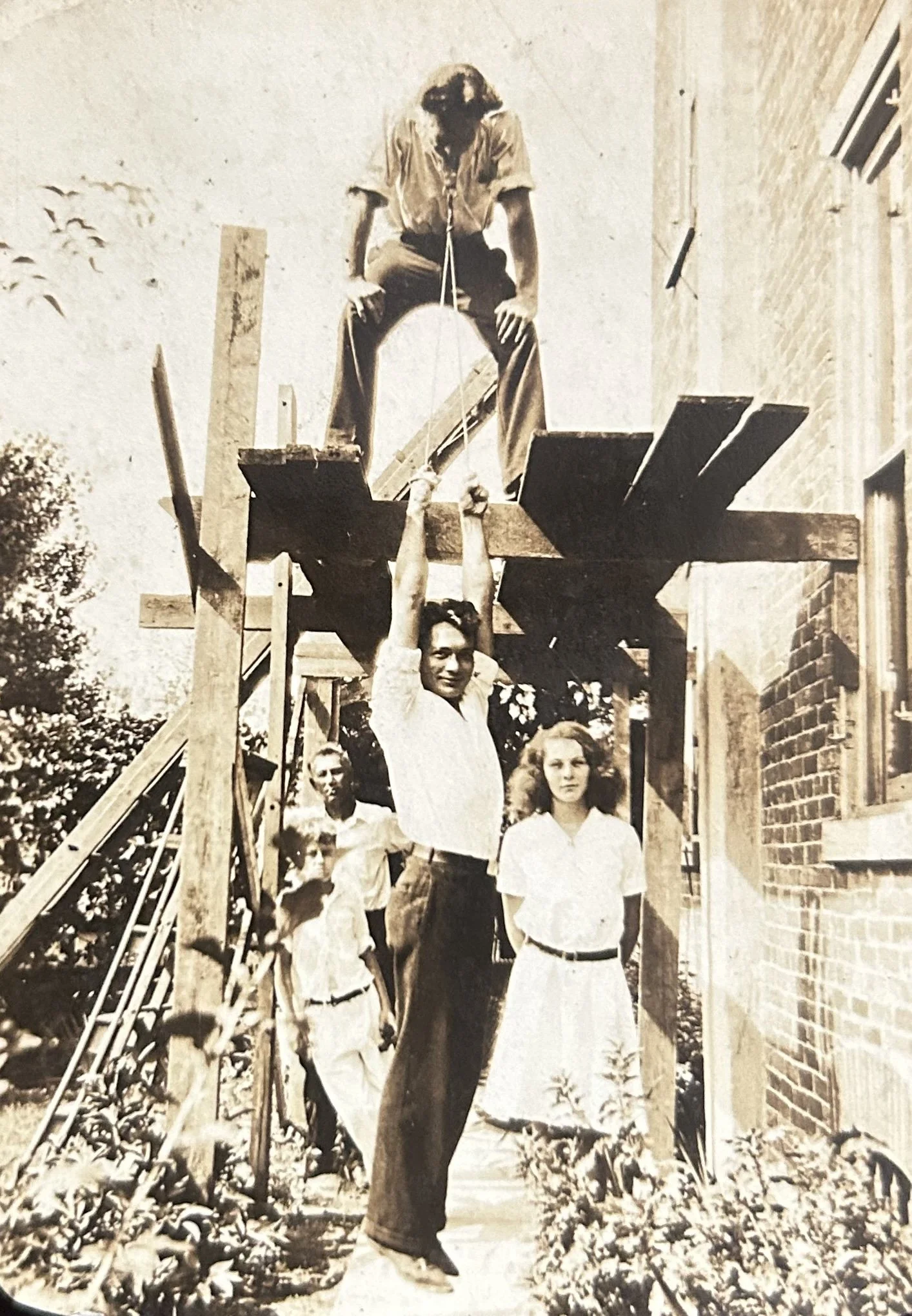
George Franklin Shade, 1892-1942, lower left behind boy (personal photo)
In a box of my old family photos is a snapshot from about 1932 of my grandfather George Lengel, a bodybuilder, truck driver, and factory worker from Reading, Pennsylvania, standing atop an elevated plank board, holding in his teeth the handle of a length of chain, using only his neck muscles to lift up his younger brother Marty, dangling from the chain’s opposite end. Standing in the background under an awning, watching the scene, is a gaunt, gray-haired man who looks twenty years older than his actual age of about forty years. So far as I know, it’s the only remaining picture of my grandfather’s uncle, George Franklin Shade, a World War I Doughboy who never showed up on the casualty lists, but whose life was ruined and cut short by his experiences.
As a budding young historian interested in military history back in the 1980s, I had asked my grandparents about Shade; but all they ever said was that he had been gassed in the Argonne Forest, couldn’t stop coughing, wasted away after he came home to Reading, and that he had died young. The records showed that Shade had died in Philadelphia’s Naval Hospital in 1942, aged fifty. The death certificate says he had lung cancer (common in men who had been gassed, although the cigarette dangling from his mouth in the photo didn’t help!). Census and other records showed he couldn’t hold down a job after returning home in 1919; he married, but was accused of abandoning his wife and daughter (who later died without children of her own), divorced, and died alone and mostly forgotten.
I partly dedicated my book, To Conquer Hell: The Meuse-Argonne, 1918, to my great-granduncle George Shade, but I didn’t know anything more about him until research recently uncovered a fuller, tragic story that I think is representative of many thousands of American veterans of World War I who never showed up on casualty lists but were nevertheless wounded or slain every bit as much as men who fell on the battlefields in France.
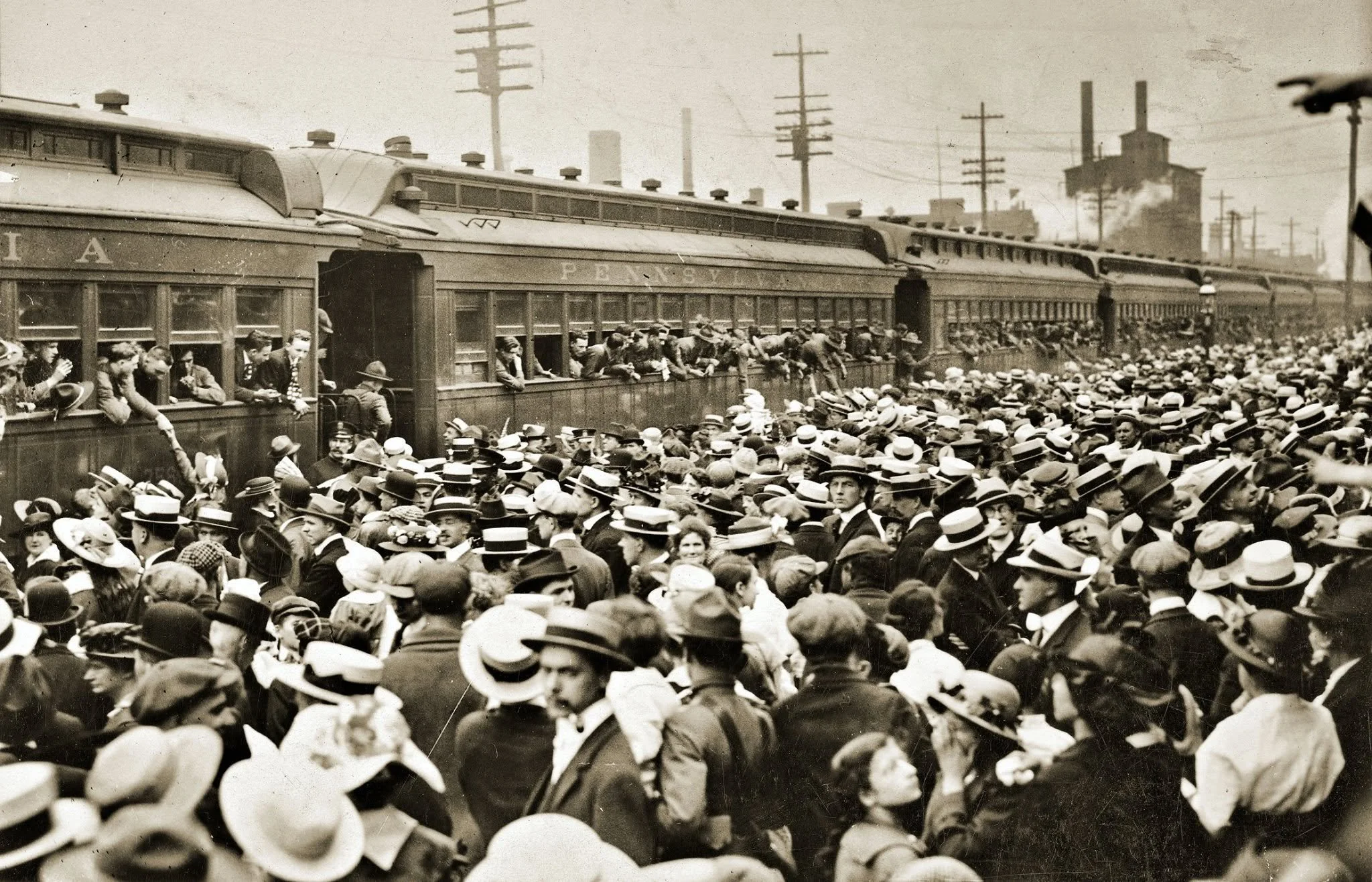
Pennsylvania National Guard mobilizing, 1917
A Cop in the Reading Militia, Pennsylvania National Guard
George Shade was a bricklayer, the family trade going back generations. On June 22, 1912, at age twenty, he enlisted in the 4th Infantry (Reading Militia), Pennsylvania National Guard; that duty apparently was only part-time, as he also became a member of the Reading police force. Shade was promoted to corporal in the Guard on July 9, 1914. As J. Bennett Nolan indicates in The Reading Militia in the Great War (1921), the Reading Militia, in Companies I (Shade’s) and A, was mobilized for national service on June 22, 1916, sent to the Mexican border to serve under General John J. Pershing, and then formally made part of the U.S. Army on July 8, 1916.
What exactly these companies did on the Mexican border I’ve not attempted to discover, and Nolan doesn’t say. But in any event, when the United States entered the war in April, 1917, their deployment was bound to change. Shade was promoted to sergeant in Company I on June 1, 1917, soon becoming mess sergeant. The two companies assembled at the Reading Armory the following month, and departed to train at Camp Mills, Long Island, in August. The company was designated to become part of a machine gun battalion, but with which division remained to be seen.
Most of the above information comes from Nolan, who notes how Company I departed from New York in October, 1917, on the filthy, overcrowded German liner-turned-transport President Grant, only to have to return after several says at sea because of engine trouble. The unit departed again on November 14 on the far-superior British transport Cedric.
Arriving in Liverpool by way of Belfast, the company assembled near Winchester, England, before making the Channel crossing to arrive in Le Havre in mid-December. Training under French instructors, the company became, initially, Company A of the 149th Machine Gun Battalion. But a new posting, and heavy combat, lay ahead.
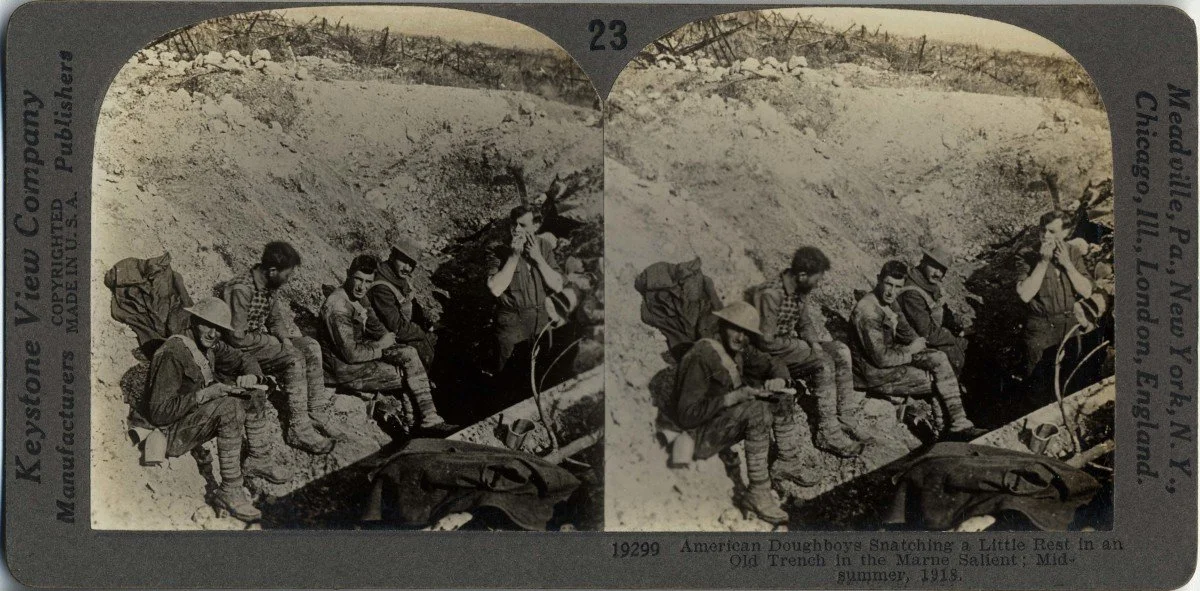
Rainbow Division Doughboys, 1918 (US Army)
150th Machine Gun Battalion, 42nd Rainbow Division
Not knowing anything about Shade’s experiences or perspective on the war, I was delighted to discover newspaper clippings on microfilm and Newspapers.com, printing letters from him to Reading Mayor Edward Filbert. The mayor obviously solicited the letters to boost home morale (and his own popularity); but still, for me, they opened a priceless window on Sergeant George Shade.
On February 9, 1918, the Reading Eagle printed a letter from “former policeman” Shade to Mayor Filbert: "I want to inform you that we have at last arrived safe in France, and all the Reading boys are in the best of health. We see very many interesting sights here, and the weather, while very cold, is agreeable. We expect to go gunning during our leisure hours for wild boar, which are very plentiful around where we are quartered. How are all the boys at home? Give them my regards and best wishes.
"The French people are very generous and hospitable to us boys and we are very considerate to them and obliging for their kindness. We cannot say how long this war will last, as we don't get the news as quickly as at home, on account of military reasons. I do not know, at this writing, how long, even after peace is declared, we will be over here.
"We had a very exciting time on our voyage, but we had nice accommodations and plenty of fun, singing and music all the time. Our meals on board ship were very good and while some became seasick, it was only for a short time."
On March 26, 1918, the company received its permanent assignment as Company D, 150th Machine Gun Battalion, part of what would become the famed 42nd Rainbow Division, American Expeditionary Forces.
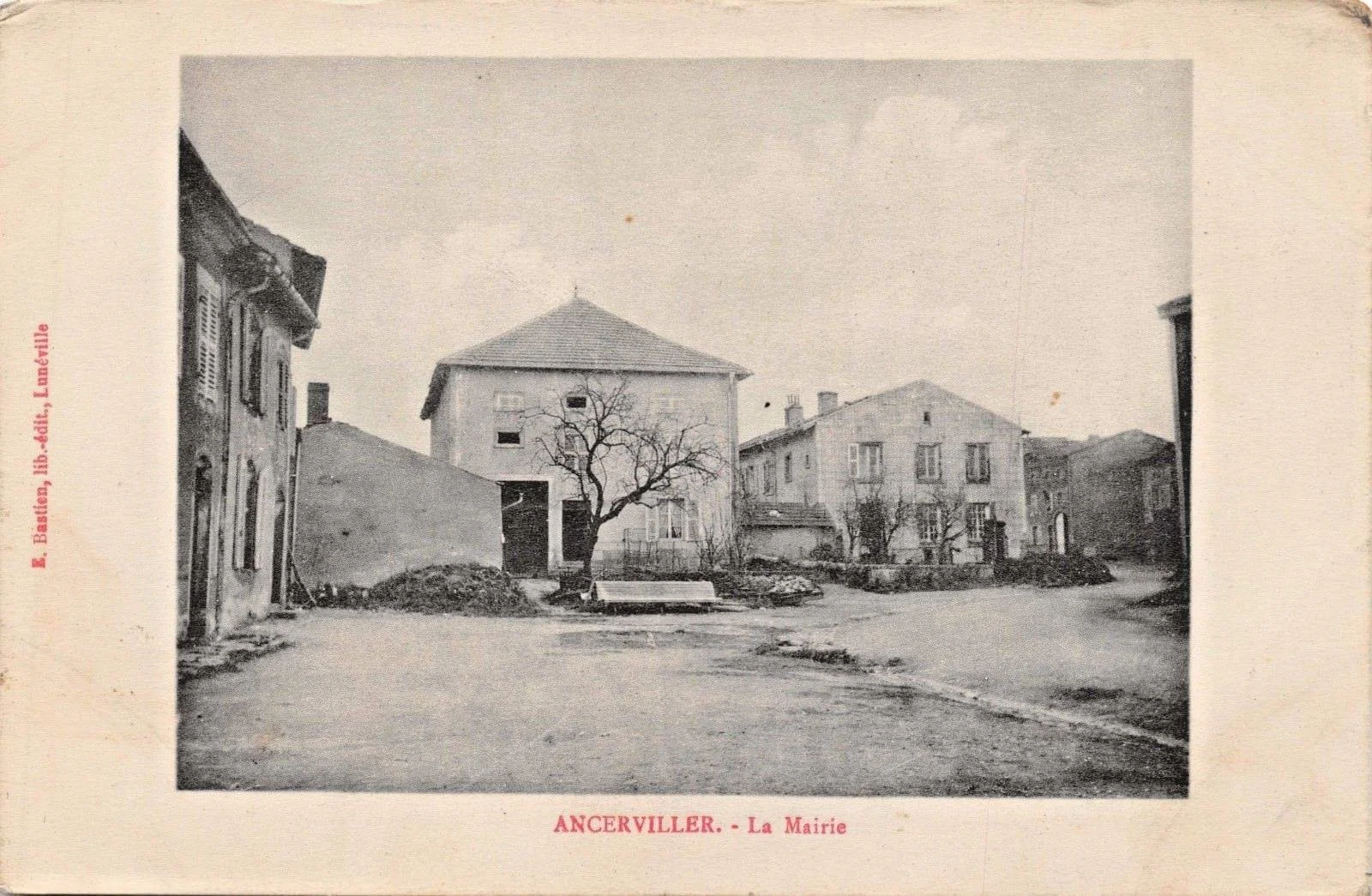
Postcard, 1918
At the Front in the Vosges
Like other American units, the 150th was introduced to the front in “quiet sectors,” in the Vosges region of Alsace—a site of horrendous fighting in 1914-1915, as it would be again in 1944-1945. In early 1918, the area was deemed proper to ease the Doughboys into trench warfare. But as Shade told a reporter after the war in 1919, the Americans refused to take it easy: “[Shade] said the Americans had been given a certain point of the line to guard which was known as a ‘quiet sector.’ But the watchful waiting style of the French got on the nerves of the aggressive Yankees who wanted some action. After a French instructor had issued a warning against opening fire, a sturdy young Yankee said in characteristic style: ‘What the hell difference does it make? What do you think we came over here for? Give ‘em action.’ And a barrage was opened on the Germans who replied and the battle was on [in] that sector.”
Nolan’s history—an excellent piece of its type, well-written, honest, and largely devoid of the kind of exaggeration typical of early unit histories—describes the intensity of these bombardments, which were heavy with poison gas and took an increasing toll of the Americans. Shade’s letters to Filbert during this period are sanitized, but still one can read between the lines to see what he was actually experiencing in what Nolan identifies as a sector near Ancerviller, about ninety kilometers west of Strasbourg.
Thus, the Reading Eagle of May 28, 1918 quotes Shade: “A few lines to let you know I am feeling fine and enjoying myself. I guess by the time you receive this letter the papers will be full about old Co. I, of Reading, having been after the Hun. Believe me, it isn't like being on the police force, and chasing after a bum. You have all kinds of noises above your head, especially when the big boys go off.
“Since we have gotten our stock I was made stable sergeant and have charge of about 30 head of horses. Don't forget to remember me to Capt. Miller [former company commander]. Tell him I get very little time to write or I would have dropped him a line. Tell him to write a few lines to the boys, as I know they would like to hear from him. I'll bet if he should see the company now, he wouldn't know it. Please remember me to my friends and tell them to write a few lines."
And again, on June 10: “[Shade] says that he is becoming accustomed to the trench life and enjoying it [sic]. The Co. I boys, according to Shade, are hearing of the Liberty Loan and other patriotic demonstrations in Reading and wish that they could be here to take part in them. He tells of seeing the small children in the French villages eating their war rations.”
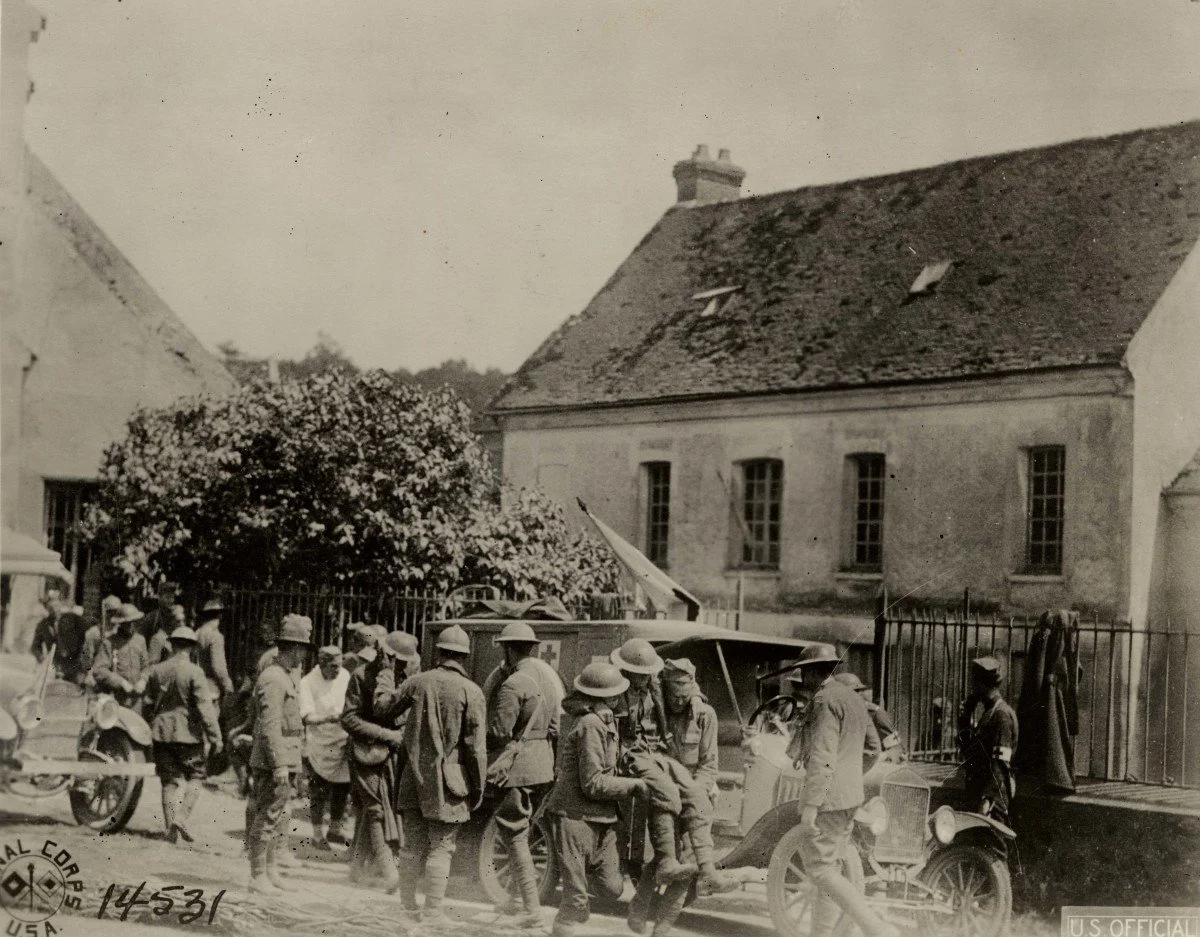
Rainbow Division Casualties, 1918 (US Army)
“Slightly” Gassed
After the war, a Reading newspaper reporter said after an interview with Shade, that: “Outside of being afflicted with rheumatism, Shade escaped without a scratch although he was slightly gassed in June. He was adjusting the gas masks on some horses when he got a whiff of it and was made ill, but felt no other serious effects.”
But, of course, there were “serious effects,” probably combined with others to come that ruined Shade’s life, though he didn’t know it yet. Perusing Nolan, it’s apparent that the event occurred during “a particularly insidious gas attack” on June 18 that, along with a severe high explosive bombardment on the following day, specifically targeted the company’s stables and killed dozens of horses and mules, along with several men. Shade didn’t comment on this, but judging from Nolan the scenes he witnessed must have been horrendous, and terrifying.
Transferring afterwards to the Vesle River and deploying near Chateau-Thierry, the company provided machine-gun support during the Marne River defense of July 15, 1918, and then participated in the Rainbow Division’s drive in the Aisne-Marne Campaign of that summer. Company D was involved in the thick of these campaigns, heavily shelled, and took dozens of casualties. All we know of Shade’s experiences, however, are some snippets he provided in letters and interviews, including: “. . . it was very hard to make the German prisoners realize that any Americans were in France, as their officers had informed them that French soldiers decked themselves out in American uniforms to deceive their opponents. The German prisoners he added, were splendidly treated by the Americans. . . . Shade inspected a number of dugouts which the Germans had built. They were equipped with almost all the modern conveniences . . . and there is nothing lacking to furnish entertainment for the officers. Many of them had player pianos.”
But Shade didn’t come through it at all well. According to the records, although I can find no explanation, he was busted to private on August 31, 1918. Malingering? Insubordination? Shell-shock? With the US Army’s personnel records having been destroyed in a 1970s fire, I’ll never know.
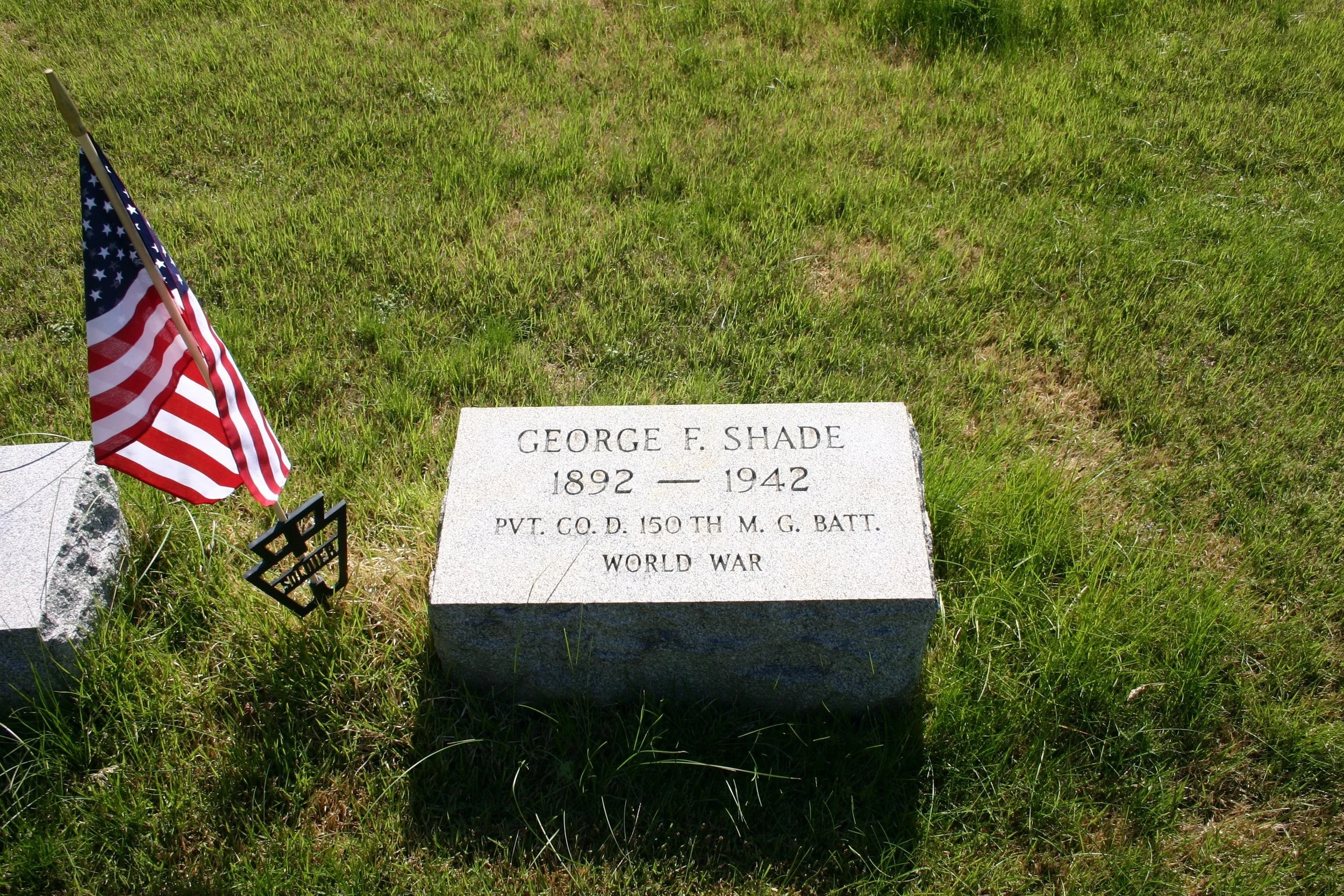
George Shade’s grave (Findagrave)
The Bitter End
What Shade did during the war’s remainder is a mystery. The 42nd Division, of course, played a large role in the Meuse-Argonne campaign beginning in October and through to November 11, but Shade and the records are silent on his experiences. All I know is that three days before the Armistice he was sent to a base hospital because of “rheumatism.” He later told a reporter: “Shade was in a hospital on the day the armistice was signed. Not any of the wounded or sick soldiers in the hospital had any inkling of the signing of the armistice until an American nurse announced that she had some welcome news for the boys. They went wild with joy when the girl said that hostilities had ended.”
By February 1919, Shade was back in Reading, where a reporter said that,” He looks the picture of health and came through his harrowing experiences in France with nothing worse than a slight whiff of gas in June 1918, [although] at the time the armistice was signed only 43 of the original 150 members of the Reading company were still in active service. The others had been killed, wounded and some were missing. This record of casualties was among the heaviest in the whole American army.”
Shade was reinstated in the Reading police force on March 12, but two weeks later he resigned in order to go into business as a shopowner. As I indicated earlier, the records show that this venture, and many others, failed in succession, as did his marriage. To all indications, by the time of the Great Depression he was a layabout, and maybe became one of the “bums” he had once chased as a policeman, before going to Philadelphia and dying penniless just after the United States entered World War II.
Writing To Conquer Hell in 2007 and, in 2015, Thunder and Flames, Americans in the Crucible of Combat, 1917-1918, and then Never in Finer Company: The Men of the Great War’s Lost Battalion (2018), I had become familiar with the stories of many former Doughboys who struggled and failed to readjust. But Shade’s story, which I have only recently uncovered, brings it all home for me. Officially, the USA suffered just over 53,000 battle deaths and over 63,000 non-battle deaths in World War I. Adding people like my great-granduncle George Shade, very much a casualty of the war, that figure should be much higher. In this blog post, I’ve done my little bit to remember this forgotten man of the Great War.