AI Revenants and Other Villainies

Audie Murphy (US Army)
The Unreturning Hero
Yes, that’s an actual photo of Medal of Honor recipient Audie Murphy, the most decorated U.S. soldier of World War II and truly, in my opinion, one of the finest Americans who ever lived. It’s not touched up; why, when you can just look in his eyes?
This kind of image isn’t good enough for many people any more, however, and indeed these days nothing is sacred. Charlatans are using AI to reimage Audie and other historical figures—I recently saw a truly despicable image on LinkedIn purporting to be Theodore Roosevelt, Jr., looking like a zombie crawling from the crypt. The creator claimed to be praising Teddy, but you have to wonder if the image was deliberately defamatory.
But there’s worse. The Theodore Roosevelt Presidential Library now has an AI revenant of Teddy himself, allegedly fed thousands of his manuscript letters (more on that below) in order to recreate the “real” man. He even had chats with President Trump and Doris Kearns Goodwin, so you know he must be the real deal! . . . wait, who let P.T. Barnum in the room?
A few years ago, just when the current AI craze was beginning to take off, I attended a public assembly (never mind where) dedicated to the memory of Audie Murphy. An AI huckster appeared, and gave a speech: he was going to create a virtual Medal of Honor museum where all of the recipients would come alive, for real. Who would be the visitors’ concierge to this gallery of heroes-turned AI rogues? None other than Audie Murphy! By feeding into the AI bot all of Audie’s films, all of his photos, all of his letters, his memoir To Hell and Back, and all of his newspaper interviews, our speaker assured us that he would create not just a simulated Audie, but the genuine article, for us to interact with.
My jaw dropped a little at that, but I can assure you that it dropped much further when I looked around in the audience—mostly older folks—and saw them nodding happily, oohing and aahing. I thought for a moment I was at an AI Tent Revival meeting.
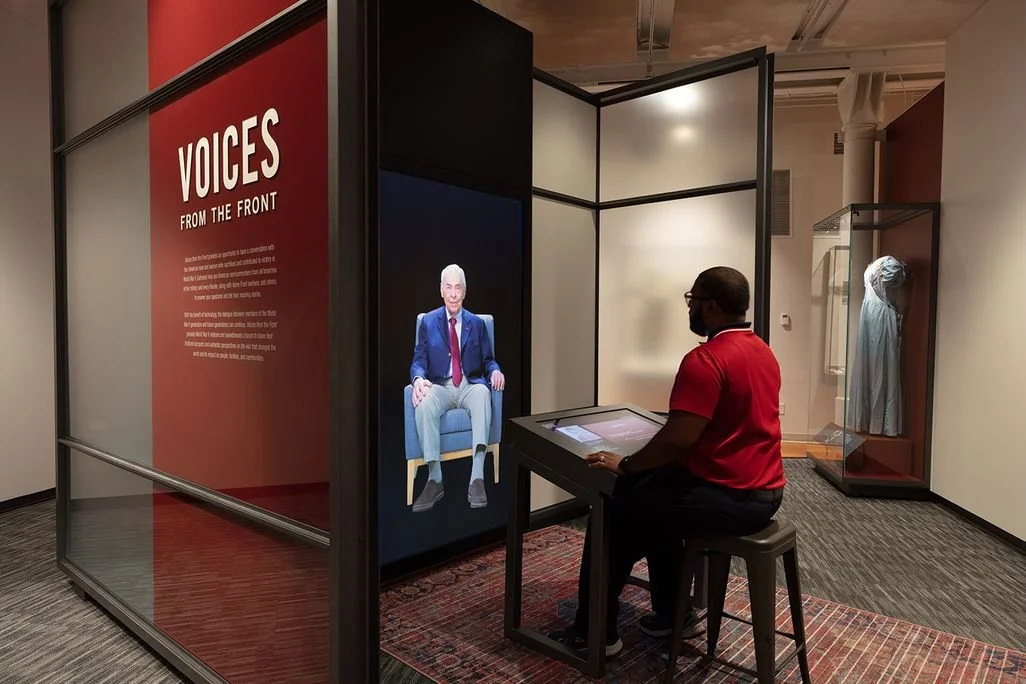
Virtual World War II Veteran (National WWII Museum)
A Historical Hero as Your Personal Chatbot?
At the time the above happened, I was working at the National Medal of Honor Museum in Arlington, Texas. I was the senior member of a team charged with working with a professional exhibit design firm to craft the exhibits and interactives.
One of the things I and others wanted to do was to create a version of the ‘Virtual Holocaust Survivor’ and ‘Virtual World War II Veteran’ developed at USC’s Shoah Foundation and the National World War II Museum (where I had also worked). Now this is a great technology, and although it is called “AI” it’s not as bad as it sounds. Instead of creating fake or pseudo-genuine content, it derives from actual filmed testimony of living survivors and veterans. You can chat with them using voice recognition technology, but the responses you get are all filmed, genuine testimony, given with full knowledge and intent by the subject—nothing’s simulated, although critics have still questioned how certain responses are generated.
As I said, I wanted to employ this at my museum with living Medal of Honor recipients, but before choosing a partner we had to review several proposals from various companies. Two of them were extremely enthusiastic, but they pushed hard to get us to agree to revive not just living but long-deceased recipients, whom the techies assured us that, using AI, they could recreate with 100% accuracy. Their excitement and desire to do this resembled missionary zeal; and in one instance I found the apostle almost threatening, suggesting that I would be worse than a fool to refuse.
I refused (and I received no pushback from anyone else at the museum). Still, the experience remains profoundly unsettling.
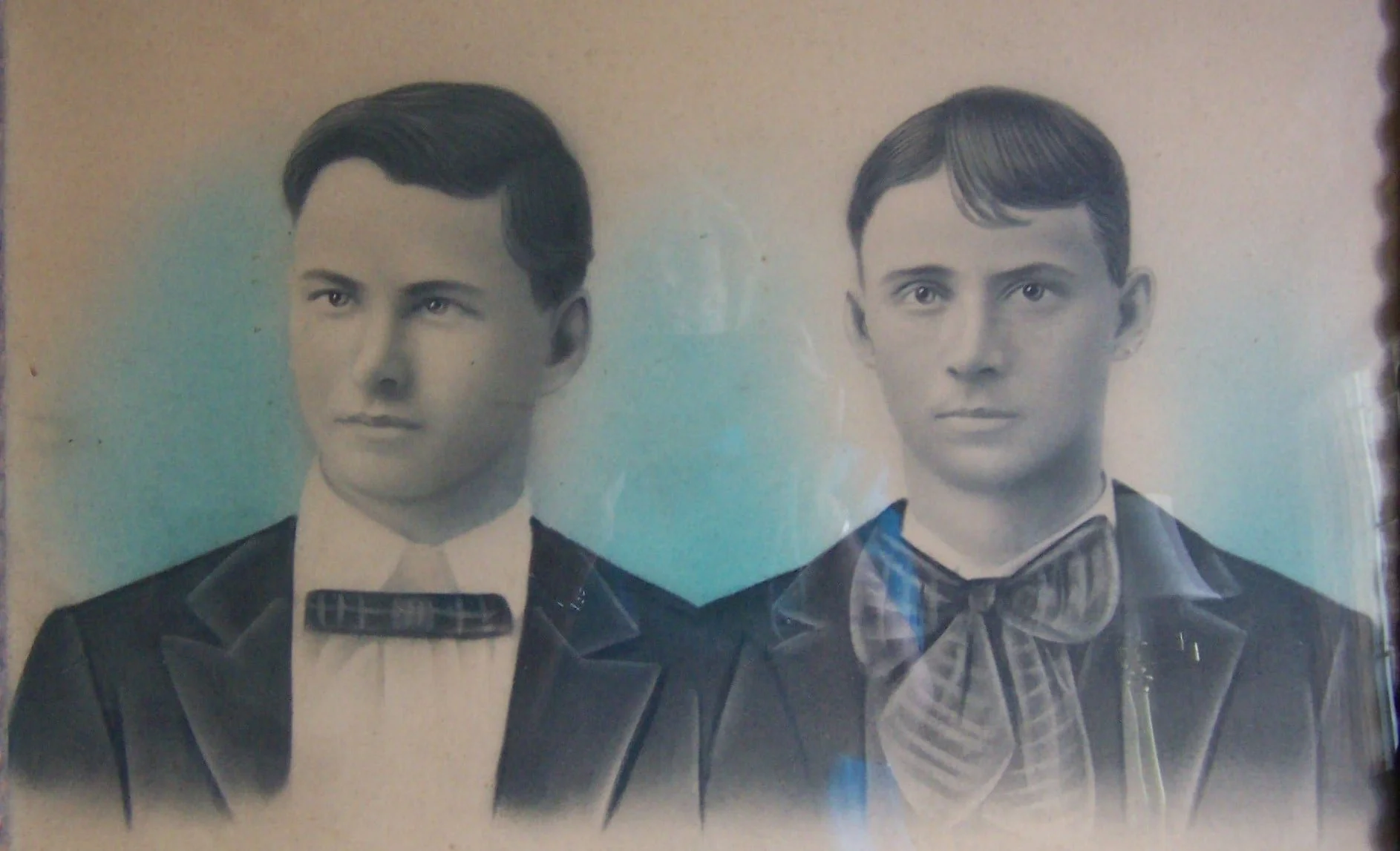
Some of my kin (personal photo)
Let’s Reanimate Great-Grandma!
Well, it’s never been easier if you really want to. In fact, Ancestry dot com seems to be embracing AI in several respects; and every company into AI, including Meta, gives you the option to animate your old photos, whether of yourself or relatives. I admit it, I’ve tried it several times. It’s interesting and amusing at first, but then it becomes weird and creepy.
It’s not just the photo of four-year-old me holding a cat that, when animated, turns into a dog; or the other physical transmogrifications, deranged facial expressions clearly borrowed from some generic “type,” and so on. Even “good” animations are unsettling. Those old photos of crumpled, glaring, nineteenth century ancestors? The one where your great-great grandmother is standing next to her long-bearded husband looking like she’d like to strangle somebody? Animate it with AI, and watch them turn to each other with broad twenty-first century smiles and postures, chatting and laughing.
Except: in actual reality, great-great grandma had good reason to look a little sour. She just had the last of her fifteen children. She has rotten teeth and has been working all day, maybe eating some corn mash because it’s all she can handle. Her husband was an alcoholic and they hated each other.
Need I go on? Your animated old photo is not just a fake, a fantasy, but it turns your ancestors into what they were not, disgracefully vaporizing their hardships, accomplishments, their real lives, their personalities with all the good, bad and in the middle—challenges and characteristics that you might embody, repeat, learn from.
You animated their photos, and you disgraced their memories. Don’t feel bad, I did it too, and I regret it (plus those companies save the image data to further train AI).
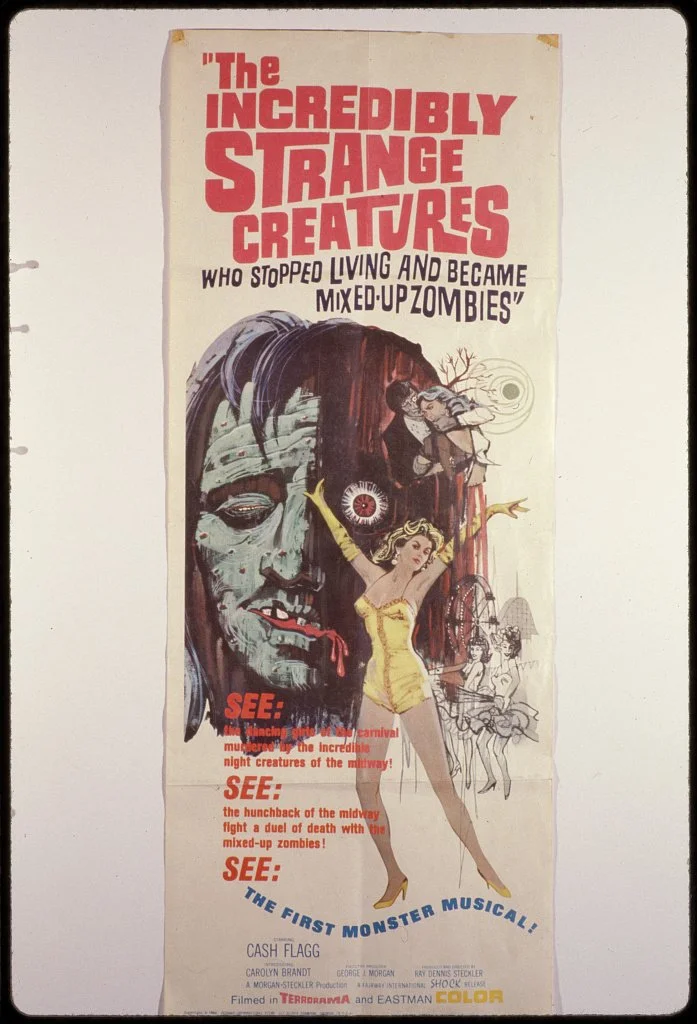
Movie Poster (Library of Congress)
Dr. Frankenstein’s Fails
Let’s state a few things that really should be obvious, and use Audie Murphy as an initial example (I could use Teddy Roosevelt, but who am I to argue with Trump and Goodwin?). Feed the AI bot all Murphy’s movies: Audie hated acting, he did it for money, and wasn’t terribly good at it. Hollywood typecast him as a man of violence, a killer about to crack; but that wasn’t him. Feed in his memoir, To Hell and Back; it’s ghostwritten, completely unreliable. Feed in all his newspaper interviews: Audie notoriously told different versions of his experiences to every journalist he met, telling them what he thought they wanted to hear. Feed in his personal writings: there aren’t many of them, he kept them brief to conceal his limited country education, and he also didn’t reveal his thoughts openly. Your AI Audie Bot is going to be pure junk, a lie, a slander of a good man.
Let’s try another example: I have been outspoken about PragerU’s implementation of AI Founding Fathers in the White House visitors’ center; bots which were exposed by journalists for parroting the words of modern conservative commentators (I won’t use a screenshot of it here because of rights concerns; but if you google “PragerU founders museum npr” you’ll see the ludicrous images—you can do the same with Teddy or, better yet, ask your AI chatbot, who will tell you how awesome he is as a bot, and share pictures!). PragerU staff evidently fed the writings of the Founders, available online—and other unspecified stuff too—to train their ridiculously grinning AI Founders.
Journalists have castigated PragerU for filtering conservative idealogy through their FounderBots. To me this is beside the point; I don’t care if a leftist or a rightist or anyone in between who Bots the Founders or other historical characters—anyway they do it, it’s despicable, disgraceful, and intellectually toxic.
Why? Should be obvious. No person is a collection of data (which is all AI can see); the sum of the letters they wrote, or the things they said over time. None of these represent their actual selves, which largely remain deeply hidden from view. Moreover, every person always is in the process of becoming, of changing into someone else. They may regret, renounce, reconsider things they said before; say them differently to different people at different times. Hide meanings.
An intelligent human trained to research history can tease these things out, understanding how subjects changed. This is all elementary psychology, basic history. A bot can only understand a lifetime’s works, sayings, writings, images, as a mashed-up data blob, presenting all things at once as reality.
PragerU’s AI Founder Bots, like all the others including the Roosevelt Library (which has lost all of my respect) and its’ “Teddy,” are monstrously warped parodies of the actual people they supposedly represent. Put another way, they are slanderous misrepresentations, and in my opinion PragerU and the Roosevelt Library, like other AI hucksters and implementers, displayed their actual contempt for the Founders, and other historical personages, in creating them.
But chew on this for a moment: people like this stuff. Worse, they’re coming to believe these monstrous Golems are real.

A Fearsome Critter - more or less representative of the AI “menace” (Wikimedia Commons)
Conclusion: Who’s Worse, the Bot or its Master?
Hucksters relish the image of AI as a hulking monster, filled with massive, intimidating potential, and deride its critics as fear-mongers. Anthropic’s CEO was recently in the news, spewing the corporate line that AI will soon do everything better than people. That helps them generate buzz, and a sense of inevitability (I recently read one otherwise intelligent commentator blurt, “It’s the future! Fighting it is a mug’s game.” George Lucas apparently recently said the same) I, however, being a hopeless mug, think more of AI as a snarling Chihuahua on the end of a leash held by Rambo. (I won’t create an AI image of that—imagine it). Rambo—replete with guns, knives, belts of ammunition, hulking muscles—nods at the little dog and says: “Watch out—he bites!”
To say AI is overhyped is a huge understatement. Not to speak for other applications, but in my field, the humanities, it’s demonstrably inept. As a technology I don’t fear it at all. What I do fear is the master, and I fear his humanity. What humans are capable of makes Rambo look like a ninny. Right now, AI is most accomplished in two fields: scamming and pornography. Is there any doubt people will soon seek to use this tool for greater evils, such as elements of a techie surveillance state? Yet if the tool itself isn’t so formidable, why be afraid? Because, the greatest danger in the face of the AI scam is mental and moral passivity, and we live at a time when humanity has never been more gullible.
For all its critical flaws, AI has given bad people the ability to replicate little monsters on a massive scale; and big tech companies and its flunkies are working relentlessly to induce dependence on AI for everyone, at all stages of life, including small children. Their goal for now, simply, is profit—with the trillions of dollars invested, they can’t do otherwise, lest they face financial collapse.
However: at a time when the impartation of bad information—even hateful information—is increasingly passively accepted by young people not accustomed to thinking critically; who think they must be “trained” to properly become acolytes of the once-extremist but increasingly mainstream movements they follow—when will AI revenants become used not just to entertain, mislead, and generate profit, but for far worse things?
You don’t need to generate an AI image to capture this. Your imagination, and history’s example, is enough.