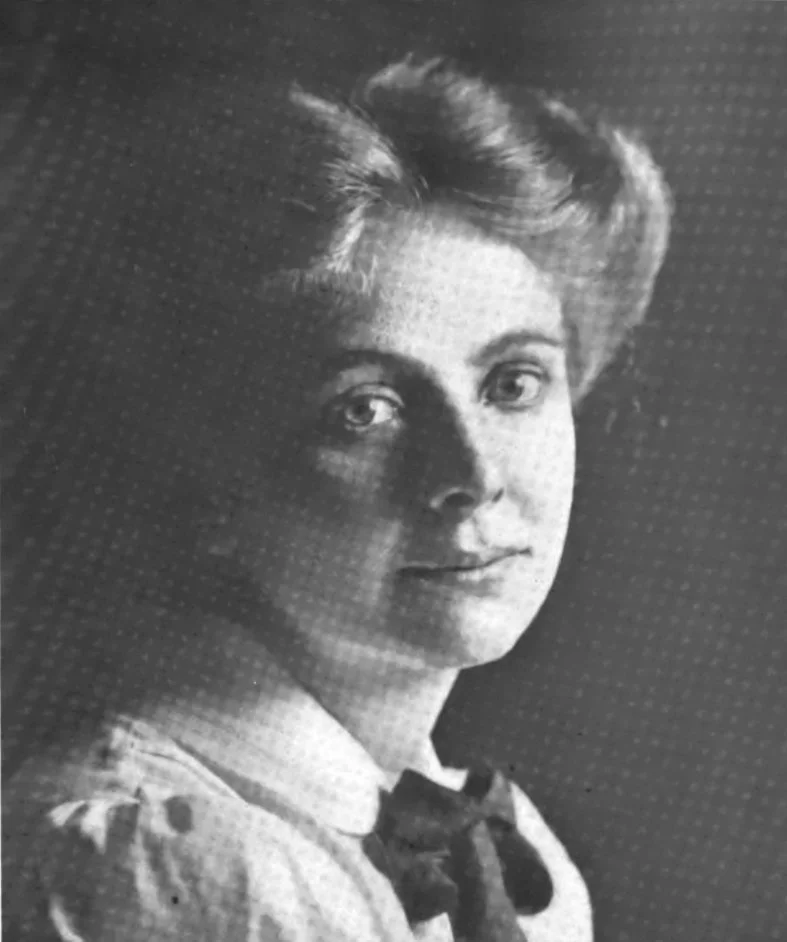
Margaret Mayo, circa 1910 (Wikipedia)
Reviewing Margaret Mayo, Trouping for the Troops: Fun-Making at the Front (1919)
About twenty-five years ago I gave a talk about war memoirs at a World War I historical organization. In the course of surveying my favorites I mentioned one I didn’t like—The Big Show by Elsie Janis (1919)—and I got a little too snarky (a failing of mine still). The book’s frontispiece, showing Janis cavorting happily in “A Very Smart Little French Trench,” just set me off, as did the sanitized, ‘war is just a big game’ tone of much of the text.
After my talk, just as I sat down feeling rather smug, a woman in the row in front of me turned around and fixed me with a savage glare. “You don’t understand Elsie AT ALL,” she hissed, “AT ALL!” Well that took the air out of me and I now have an autographed copy of Janis’s book in my collection. Elsie did, I concede, work hard to entertain the Doughboys, and they certainly loved her.
Having just finished the far-more obscure memoir, Trouping for the Troops: Fun-Making at the Front, by actress and playwright Margaret Mayo, however, I remember why I didn’t care for Janis. Mayo, who worked every bit as hard as Janis, with far less fanfare then or now, appears to have been profoundly dedicated to the troops; she wrote well, was not meek but still self-effacing, and plainly honest in recounting her experiences. Her memoir has no tinges of propaganda, and not a single reference to the dirty Boche, instead recognizing the Doughboys’ humanity and often individual flaws with complete openness and compassion. And Mayo, discontented with entertaining rear-echelon personnel, worked furiously to get into the battle zone, hoping especially to bring comfort not just to troops going into battle, but especially those returning from it. To a great degree she succeeded.
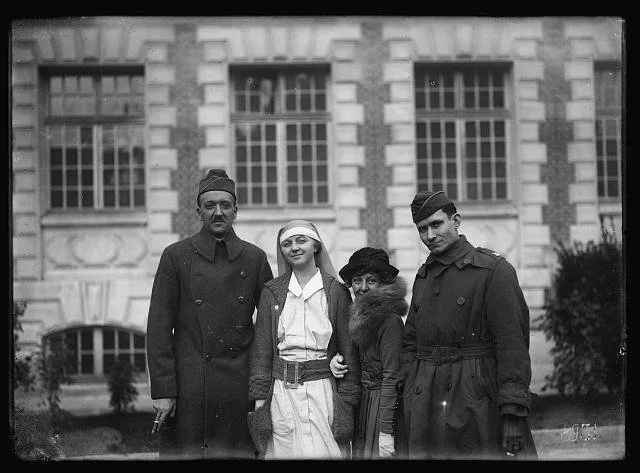
Margaret Mayo, second from left, with two Marine officers and Nurse Ruth Harding, Bae Hospital No. 1, 1918 (Library of Congress)
Talented Artist, Courageous Woman
Born in Illinois in 1882, Mayo began acting on the New York stage as a teenager but quickly transitioned to becoming a playwright. Several of her plays were remarkably successful—though none are well-remembered now—and in 1917 she began working to convert her stage work into film. In 1918, though, she elected to go to France to entertain American troops as part of a troupe that included Vaudeville star Elizabeth Brice and many other A-listers of the time.
Trouping for the Troops begins with Mayo’s arrival in France at the beginning of September 1918, after her ship abandoned its convoy and risked being torpedoed by making the crossing alone. Her group first went to Paris, but Mayo was restless, and successfully pushed through official resistance to move toward the front. Her next stop was Chaumont, near Pershing’s chateau, where her efforts threatened to bog down into constantly entertaining rear-echelon troops. After encountering a general (I think James Harbord, though he isn’t named) who had commanded troops at Belleau Wood, who spoke of how troops just emerging from battle especially needed the kind of distraction Mayo’s troup offered, she pushed ahead as close to the battle zone as she could manage.
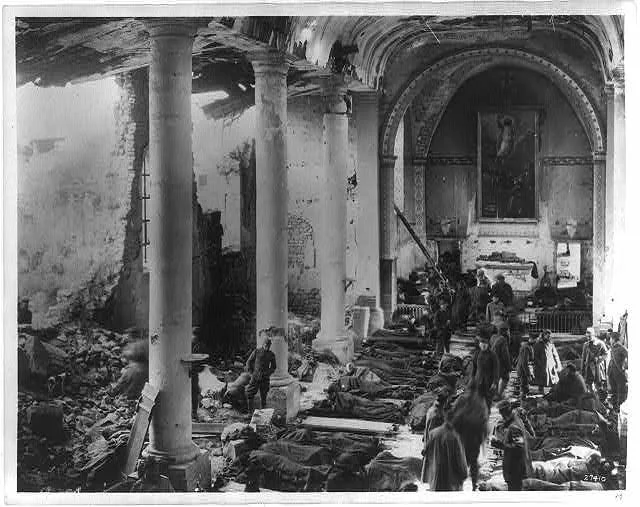
A field hospital n Esnes, Meuse-Argonne, 1918 (Library of Congress)
The Mayo Shock Unit
Since Trouping for the Troops was mostly written during the war, Mayo isn’t very specific about locations, but she did get within a couple of miles of the front lines. Among the troops she encountered and her troup entertained were black Doughboys, apparently of the 92nd Division, soldiers of the 81st and 91st Divisions, and elements of the 77th Division—she got close enough to witness planes loading supplies to drop to the Lost Battalion under Major Charles Whittlesey.
The troup—which became known as the “Mayo Shock Unit” for haunting the battle zone more closely than other entertainers were able or willing to venture, witnessed the beginnings of the St. Mihiel and Meuse-Argonne offensives. Mayo and her companions sometimes slept on cots, or on filthy floors in ruined and rat-infested homes, observing work, traffic congestion and other events in the front’s immediate rear. Among the notables she met there were Damon Runyon, Claire Kenamore, Eddie Rickenbacker, and Douglas MacArthur.
In addition to her willingness to get close to the fighting, one can’t help but admire how Mayo circumvented generals and staff to meet and interact with individual Doughboys—not just in set-piece shows, but in casual conversation. She portrays them honestly, commenting on their strength and dreams, hopes and fears, their griping, and even noticing malingerers and deserters, none of whom she judged. There’s no tinsel in her depiction of the common soldiers. “They have no false sentimentality to buoy them up,” she writes, “no love of adventure, no inborn lust of blood, nothing but a frank abhorrence for the wholesale butchery and brutality into which they find themselves plunged and a steady stoical determination to see the job through.”
And that, finally, is what sets Mayo apart for me. Though her love for the troops is palpable, she views the war as a tragedy, not overlooking its many cruelties, including to animals. In one touching scene, she intervenes to rescue a badly wounded horse that had been tied up and abandoned; and she even comments unsettlingly (but without moralizing) on animals used for experiments to test poison gas.
In conclusion, Trouping for the Troops deserves reconsideration and far wider reading. Mayo was a talented, intelligent, hard-working and courageous woman. My Goodreads rating: four out of five stars.