Quelling Riot in New York City’s Red Light District, 1776: George Washington @ 250
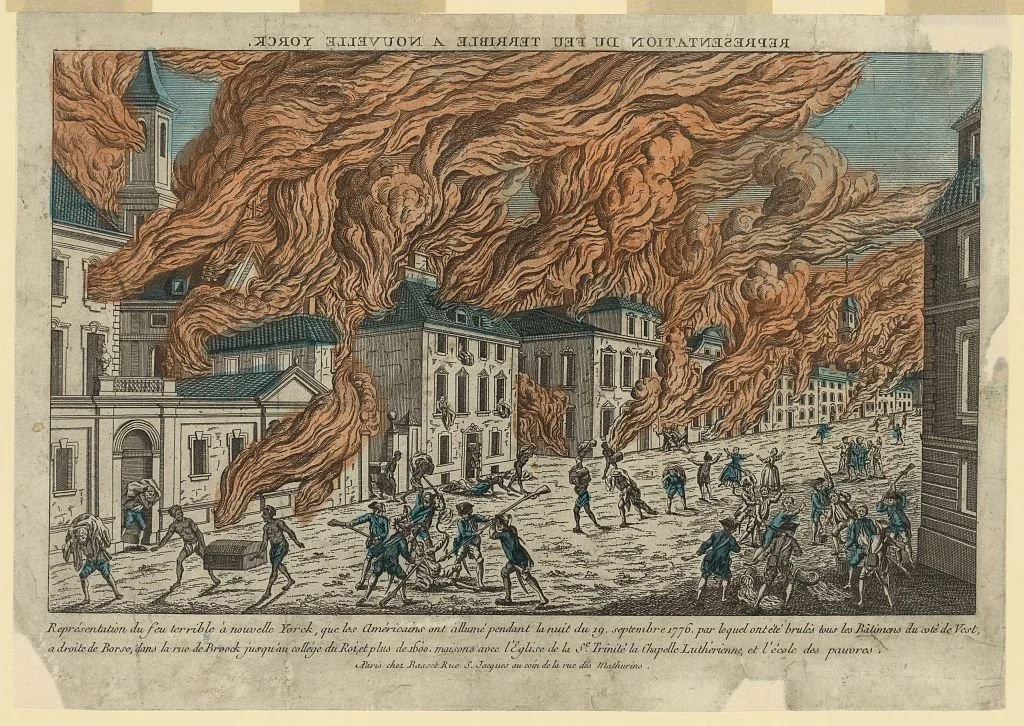
The New York City Fire of September 1776 (Library of Congress)
The last week of April, 1776, found Commander-in-Chief George Washington in New York City, trying to wrap his mind around a thousand tasks and responsibilities. At times such as these he became truly embedded in what he called the “sinews of warfare.”
Among the things he had to contend with were: sending six Continental infantry regiments to Canada to reinforce the small army bogged down outside Quebec; working out terms of a possible prisoner exchange with the British; rank disputes among his officers and courts-martial of military malefactors, including those guilty of crimes against civilians; shortages of muskets, artillery, and provisions; and above all financial shortfalls that forced the general to send most of his militia home for lack of money to pay them.
There was even, on April 26, a riot of Continental troops in an area of the city ironically called the “Holy Ground,” near Trinity Church. This was actually the Red Light District, where Continentals accessed the city’s prostitutes, risking not just infection but robbery and other mayhem. When local thugs murdered two roving Continentals in this district and horrifically mutilated another, vengeful soldiers stormed the “Holy Ground” and tore down two houses where the crimes had taken place.
Washington’s rebuke of the rioters was stern, but qualified. He declared in General Orders that the rampage: “has filled the General with much regret, and concern; and lays him under the disagreeable necessity of declaring, that if the like behaviour should be practiced again, the Authors will be brought to the severest punishment if taken, or treated as a common Enemy, if they dare to resist—Men are not to carve out Remedies for themselves—If they are injured in any respect, there are legal Modes to obtain relief; and just Complaints will always be attended to, and redressed.” But none apparently were actually punished.
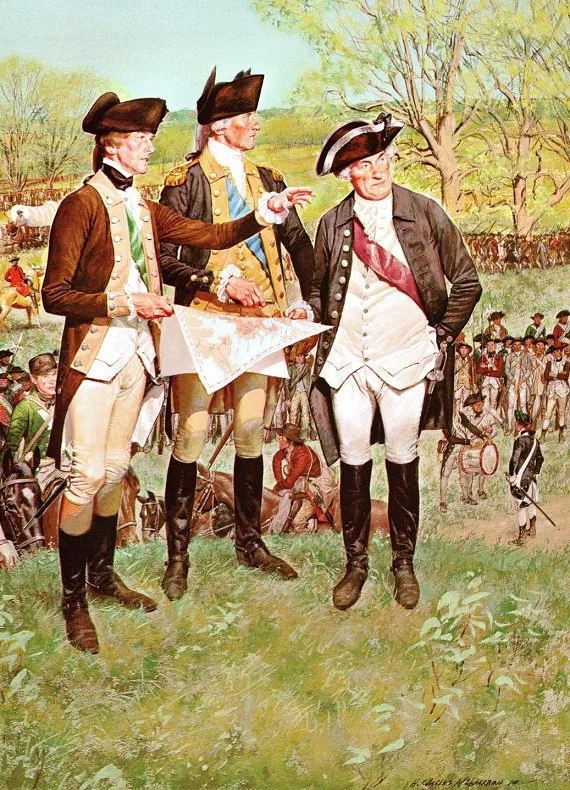
Officers and an aide-de-camp (US Army)
A Good Boss Advocates for His Subordinates
Among the many problems caused by lack of funds was Washington’s inability to pay his aides-de-camp and secretaries—the folks he called his “military family”—anything close to what they deserved. But Washington had no problem with advocating forcefully for his subordinates, and for that purpose he wrote to Continental Congress President John Hancock on April 23. His words are worth repeating at length to show how his headquarters worked:
“Aid de Camps are person’s in whom entire Confidence must be placed—It requires Men of abilities to execute the duties with propriety and dispatch where there is such a multiplicity of business as must attend the Commander in chief of such an army as our’s; and perswaded I am that nothing but the zeal of those Gentlemen who live with me and act in this capacity for the great American Cause and personal attachment to me, has induced them to undergo the trouble and confinement they have experienced since they have become Members of my Family.
“I give into no kind of amusements myself, consequently those about me can have none, but are confined from morn till Eve hearing, and answering the applications and Letters of one and another; which will now, I expect, receive a pretty considerable addition as the business of the Northern and Eastern departments (if I continue here) must, I suppose, pass through my hands—If these Gentlemen had the same relaxation from duty as other Officers have in their common Rotine, there would not be so much in it, but to have the Mind always upon the stretch—scarce ever unbent—and no hours for recreation, makes a material odds—knowing this, and at the sametime how inadequate the pay is, I can scarce find Inclination to impose the necessary duties of their Office upon them.”
The pressure paid off—Congress assigned the rank of lieutenant colonel to Washington’s aides-de-camp and secretaries alike, and agreed to pay each $40 a month—not princely, but commensurate with their new rank.