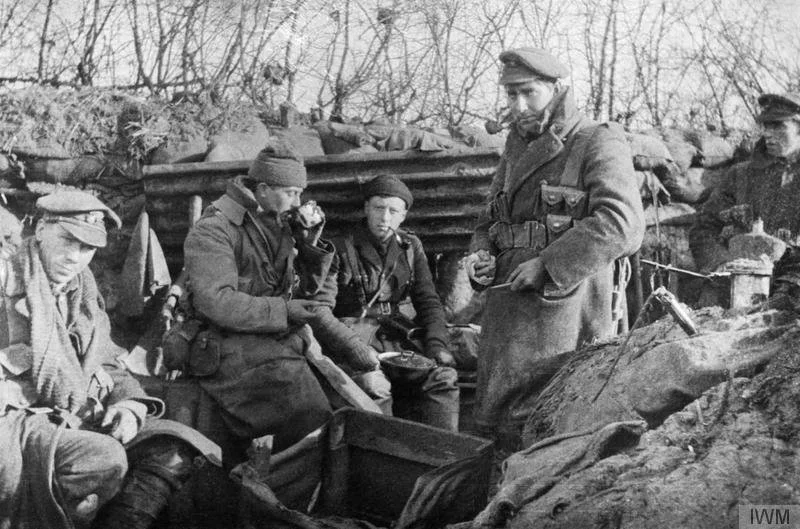
Men of the Honourable Artillery Company in the Ypres Salient, 1915 (Imperial War Museums)
Review of One Mole Rampant, by Walter Gardner (1920)
After more than 35 years dedicated to collecting and reading personal accounts of the First World War, it’s a pleasant surprise to discover a hidden gem. That’s certainly the case with One Mole Rampant, an exceedingly rare memoir originally published in a small print run in 1920 and reissued a few years ago by Naval and Military Press but, so far as I can see, largely unknown (though I’ll stand corrected by my readers who do know it). I was so impressed after reading this memoir online on Open Library that I shelled out a tidy sum to purchase the only original edition—signed by the author—that I could find for sale (I have no interest in the tacky made-in-India print on demand public domain books all over the place).
The author, given on the title page as “W.G.” and calling himself “the Mole,” was Walter Gardner. I have been unable to discover much about him online (here again I welcome input from others); but from indications in the memoir he was an English public school boy, the son of an industrialist, and a mining engineer who studied his trade at Columbia University, New York before returning to Great Britain.
When the Great War broke out, Gardner elected not to seek an officer’s commission immediately for fear that it would take too much time (although, unlike many others, he was under no illusions that the war would end quickly). Instead, he decided to enlist, and so in September 1914 found himself serving as a private with the Honourable Artillery Company—one of the British Army’s more storied and unusual units, dating from 1537 and at the Great War’s outbreak actually a half, and then a full infantry battalion—not an artillery unit. Gardner served as a pioneer in the unit’s 4th Company.
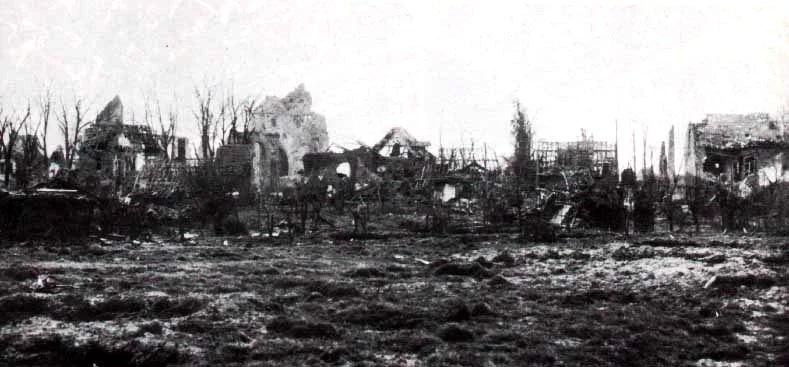
Langemarck, Ypres Saliet, October 1914 (Wikimedia Commons/public domain)
The Honourable Artillery Company
One Mole Rampant charmed me immediately with its honest, drily humorous account of the H.A.C.’s first, halting ventures at organization in England and then in western France (where it was landed for fear that the Germans might imminently capture the Channel ports). The whole effort was hasty and confused but good-natured, as no one, officers or men, really had much idea how the H.A.C. was supposed to be organized, the responsibilities of its various appointments (no one had the slightest notion of what a pioneer should do), or what the battalion’s role would be at the front.
As the battle lines began to stabilize in October 1914, though, the H.A.C. was rushed to the front essentially to plug gaps appearing in what would become the southern portion of the Ypres Salient. The H.A.C. was paired in particular with the Royal Scots, who had a very rough time in action. One Mole Rampant offers some fascinating commentary on the early origins of trench warfare. As Gardner describes, it was miserable going at first, as the H.A.C. had to occupy pulpy, devastated, water-logged ditches (not really trenches) just a few dozen yards away from the German positions, and continued to occupy them on and off through a gloomy winter in which the casualties from trench foot and exposure reduced the H.A.C. from 800 to 300 men.
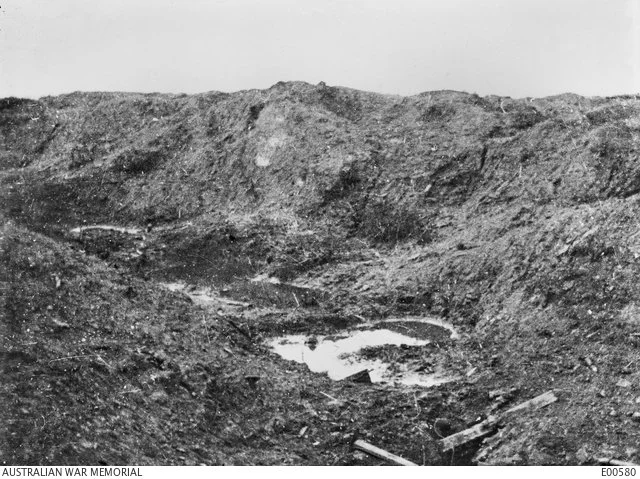
Crater at Hill 60 (Australian War Memorial)
Mining at Hill 60 and St. Eloi
Gardner—who writes with a slight but tangible (albeit never off-putting) upper-class tinge, quickly regretted not getting a commission, and avidly sought one until finally becoming a second lieutenant in March 1915. This included a transfer to the Royal Engineers, in which he served with the 172nd Tunnelling Company under Captain William Henry Johnson, V.C., who was tragically killed in June.
From April to August 1915 Gardner’s chief responsibility was in mining and counter-mining activities at St. Eloi and the legendary Hill 60. His description of this period of service, drawn from diary entries and letters with some added commentary, forms the core of One Mole Rampant and is its chief attraction. In its format, and in authenticity and detail, I found this account reminiscent of, if not quite equal to, one of my very favorite first-hand accounts, F.C. Hitchcock’s Stand To! A Diary of the Trenches 1915-1918 (1937). Nowhere else that I know of offhand, however, is the reader likely to find a more gripping (often tense) and useful account of exactly how mine warfare worked at this early stage of the war.
Gardner, who also witnessed and participated in the war’s earliest poison gas attacks during the Battle of Second Ypres, seems to have been quite successful in his combat operations, and was mentioned in dispatches. By the summer of 1915, though, he reached his personal limit for front line duty, and so did not hesitate to depart when recalled to England that August for home service with the Ministry of Munitions.
Altogether, One Mole Rampant seems to me to be a must-read for any aficionado or student of the British Army on the Western Front, and especially for anyone interested in the early trench warfare period and mining operations. My Goodreads rating: four out of five stars.