The Doomed City: New York, April 1776. George Washington @ 250
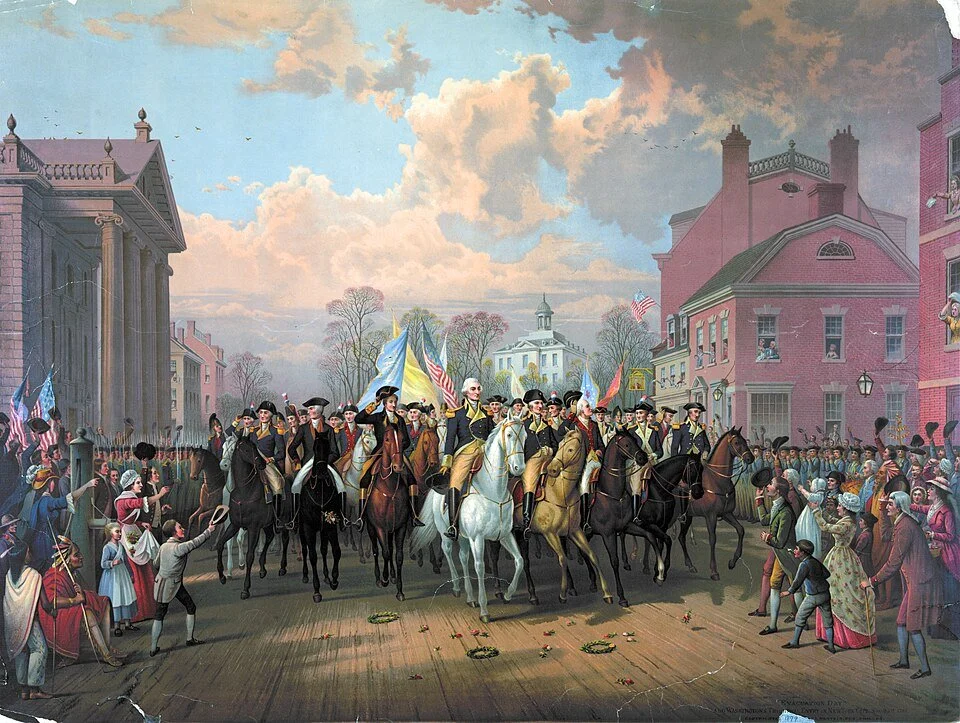
Evacuation Day: George Washington enters New York City, 1783 (Library of Congress)
A Not-So Triumphal Entry
250 years ago today, on April 13, 1776, George Washington arrived in New York City after a nine-day overland journey from Boston. No one painted a triumphal entry, as depicted in the above painting from his return in 1783. In fact, few people even noticed.
He established headquarters in a town house, at what is now Pearl and Cedar Streets, owned by William Smith; but apparently he stayed with Martha, who arrived four days later, in Abraham Mortier’s mansion, Richmond Hill, now at Varick and Charlton Streets. George’s location in the city at any given time is often hard to establish, however, and he moved from place to place.
What were his initial priorities?
First, head off any possible smallpox epidemic—which had devastated many armies throughout history, as Washington well knew—by getting the troops inoculated.
Next, he turned to consider the soldiers’ temper, and above all their fighting disposition. Nothing could be taken for granted.
In Boston, as we have seen in my previous blog posts, he had had his doubts about the troops, right up to the evacuation. Publicly, he said all the right things after arriving in New York. Writing to Continental Congress President John Hancock on April 18, Washington reflected that the soldiers “were indeed, at first ‘a band of undisciplined Husbandmen’ but it is (under God) to their bravery, & attention to their duty, that I am indebted for that success which has procured me the only reward I wish to receive—the affection, & esteem of my Countrymen.”
Nevertheless, the commander-in-chief immediately issued strict orders to the troops about discipline and proper conduct, declaring for example that he expected the troops to “pride themselves (as Men contending in the glorious Cause of Liberty ought to do) in an orderly, decent and regular deportment.”
Interestingly, his correspondence during his first week in the city contains relatively little about what one might think should be his overarching priority: fortifying the city. In General Orders on April 16, he declared: “If the British Troops which evacuated Boston, or any part of them, are destined for this place, their Arrival may be very soon expected—The Engineers and Overseers of the works, are therefore to use every possible dispatch in compleating them.” Privately, he knew these works would be of little use.
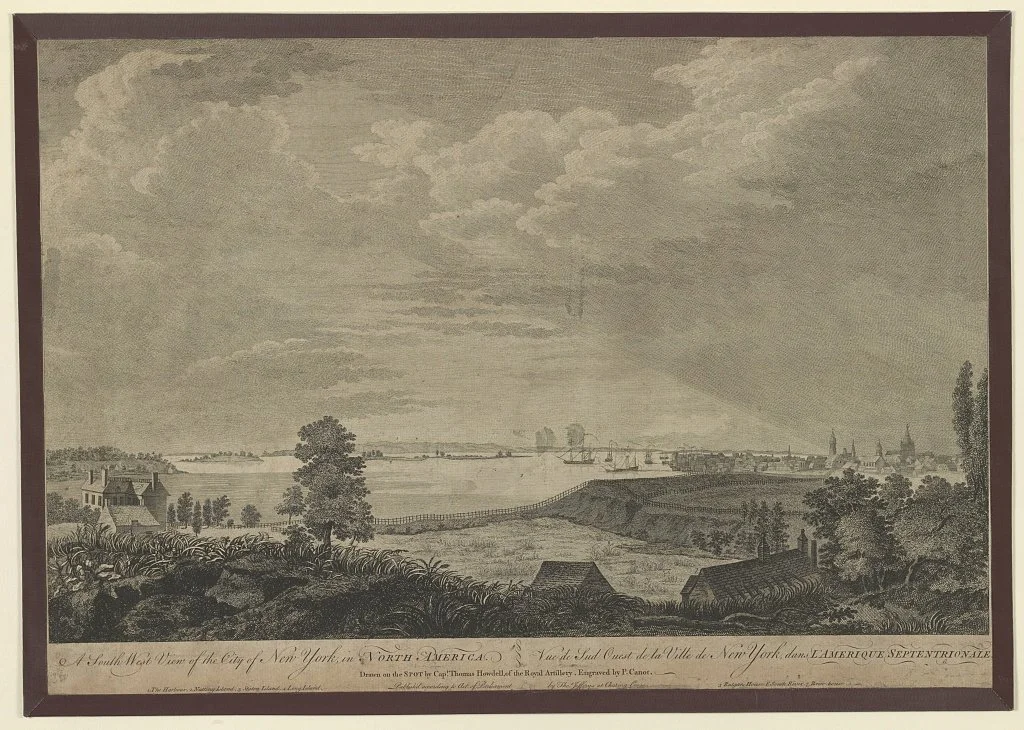
View of New York from the Southwest, 1768 (Library of Congress)
Seeking Unity, Preparing for the Worst
The road ahead promised to be a rough one, and disunity in adversity, Washington knew, could doom the cause. Writing on April 15 to John Adams about potential British peace proposals, he avowed, “I have ever thought, and am still of opinion that no terms of accomodation will be offer’d by the British Ministry, but such as cannot be accepted by America. We have nothing my Dear Sir to depend upon, but the protection of a kind Providence and Unanimity among ourselves.”
Already there were worrying signs. Washington wrote on April 15 to his friend Joseph Reed, following widespread reports of disunity in the southern colonies: “I am exceedingly concern’d to hear of the divisions & Parties which prevail . . . in the Southern Colonies on the Score of Independance &ca—these are the Shelves we have to avoid, or Our Bark will split & tumble to pieces—here lays our great danger, and I almost tremble when I think of this Rock. nothing but a disunion can hurt our cause.”
Cooperation between civil and military authorities would, he felt certain, be indispensable in the coming inevitable contest for New York; and so Washington wrote promptly to the New York Committee of Safety: “It will certainly add great weight to the measures adopted when the Civil Authority Co-operates with the Military to carry them into Execution1—It will also redound much to the honor of the Government, and of your Committee in particular, for the World is apt to judge from appearances, and while such Correspondence exists the reputation of the whole Colony will suffer in the Eyes of their American Bretheren.”
Privately, though, Washington wasn’t sure he could count on the civil authority to cooperate with him, especially since he knew the city would be so difficult to defend. Thus his heartfelt appeal to Reed: “When my good Sir will you be with me? I fear I shall have a difficult card to play in this Government, & could wish for your Assistance and advice to manage it.”
In retrospect, his premonition of a “difficult card” would be a huge understatement.