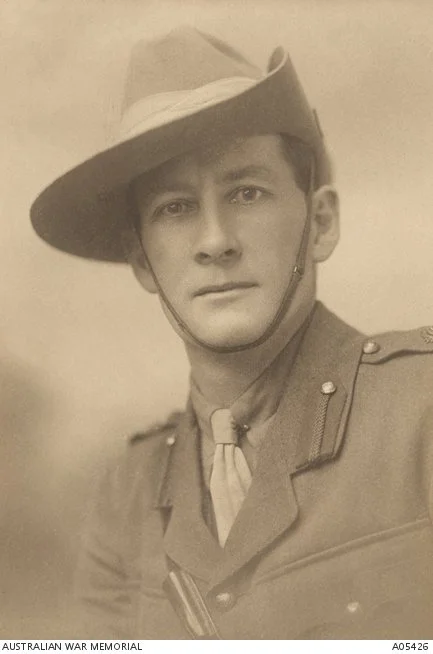
Oliver Hogue (Australian War Memorial)
Review of The Cameliers, by Oliver Hogue (1919)
Review of The Cameliers, by Oliver Hogue (1919)
When I wrote my annotated bibliography, World War I Memories, over twenty years ago, I elected not to include books published 1914-1919.
One of the reasons why I did so: books like The Cameliers.
Born in Sydney, Australia, in 1880, Oliver Hogue was enough of an athlete, the Australian War Memorial comments a little snarkily, “to consider himself a bushman.” He also was enough of an extrovert—even by Australian standards—to become a traveling salesman and then a journalist. Hogue wanted to be Australia’s official war correspondent, but was beaten out (thankfully for posterity) by the talented C.E.W. Bean.
Hogue became an officer in the Australian Light Horse instead, serving at Gallipoli before heading to Egypt in the spring of 1916. Though it is said that Hogue was a brave man who frequented the front lines, he appears to have continued to serve primarily as a journalist, writing letters back home that were published in the Sydney Morning Herald and then as books, Love Letters of an ANZAC (1916) and Trooper Bluegum of the Dardanelles (1916), both unabashedly propagandistic in tenor.
In August 1916 Hogue was transferred, along with other Light Horsemen, to the Imperial Camel Corps, and this service is chronicled in The Cameliers. Although Hogue completed the book before the war ended, it was published in 1919—sadly, around the same time he perished in the Influenza Pandemic—and so I decided to give it a read despite my usual avoidance of wartime productions.
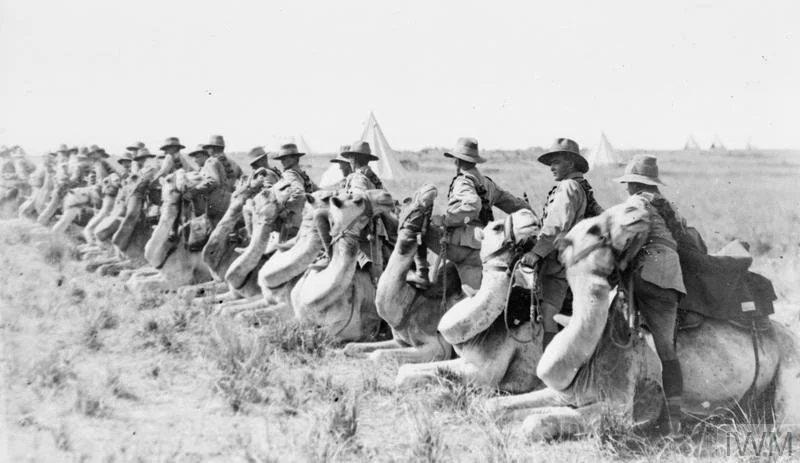
Australian Troopers of the Imperial Camel Corps (Imperial War Museums)
The Imperial Camel Corps
Eventually growing to four battalions in size and serving essentially as an atypical form of mounted infantry, the Imperial Camel Corps consisted of troops from Australia, New Zealand, Great Britain, and even Hong Kong and Singapore. It played an important role in campaigning from Sinai through Palestine to the British capture of Jerusalem under General Edmund Allenby in 1917.
Hogue certainly provides a taste of the service in The Cameliers, particularly of the (ahem) unique collective personality of the Australian and New Zealand personnel, known as they were for their courage, potency (in multiple senses of the word), humor, guile, and indiscipline. There’s verse by Hogue alternately cursing and praising the camels, and some vignettes of daily life that are interesting enough.
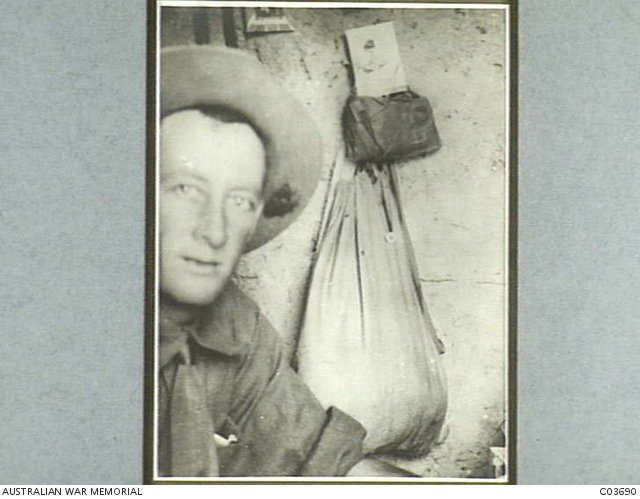
Hogue in a Dugout at Gallipoli (Australian War Memorial)
A Memoir? Really?
Hogue himself nevertheless appears to have taken little part in the fighting—his own first-hand testimonies primarily concern sporting events, a scout on which he pondered the location of the historical Mount Sinai, and a rear-area raid near Beersheeba. Accounts of the ICC’s combat activities, along with other troops under Allenby, are clearly gleaned from official dispatches and written with an irritating Boys’ Own adventure voice, with dashing cavalry charges, dastardly enemies who fight at first but then cower and then throw up their hands in terror at the sight of glinting bayonets, and so on. Battlefield wounds are always presentable, and easily laughed off. AND the Aussie troopers’ biggest vice? Gambling. Nothing else for the home folks to worry themselves about.
Worst, perhaps, are the cloyingly sentimental chapters titled “The Sister,” describing the adventures of a nurse swooning with admiration for the handsome ANZACs, writing home to Daddy about their feats (in one letter, after mentioning the death of a brave airman, she writes “that’s just an ink blot on the paper, Daddy”; need I say more?) and falls in love with a Lieutenant Blaine of the ICC, finally folding her “tiny” hands in his after he declares his undying love . . .
Cue my groan and eye roll every time one of these chapters appeared. Perhaps this love story was a fictionalized version of something Hogue experienced; more likely, it’s pure fiction.
Does a Great War memoir need to be disillusioned and focus on misery and death on order to be authentic? Of course not—elsewhere, I have praised many memoirs by veterans who regretted nothing about their service. Books such as The Cameliers, though, are hard to stomach; and arguably the book (which appears to have been thrown together from bits and pieces, perhaps by Hogue’s newspaper editor after his death) isn’t really a memoir though it is catalogued as one. Hogue was no doubt a good and brave lad, but not a memoirist (let alone a poet) of talent. My Goodreads rating: two out of five stars.