Red Arrow on the Leviathan: Michigan and Wisconsin Doughboys Go to War, 1918
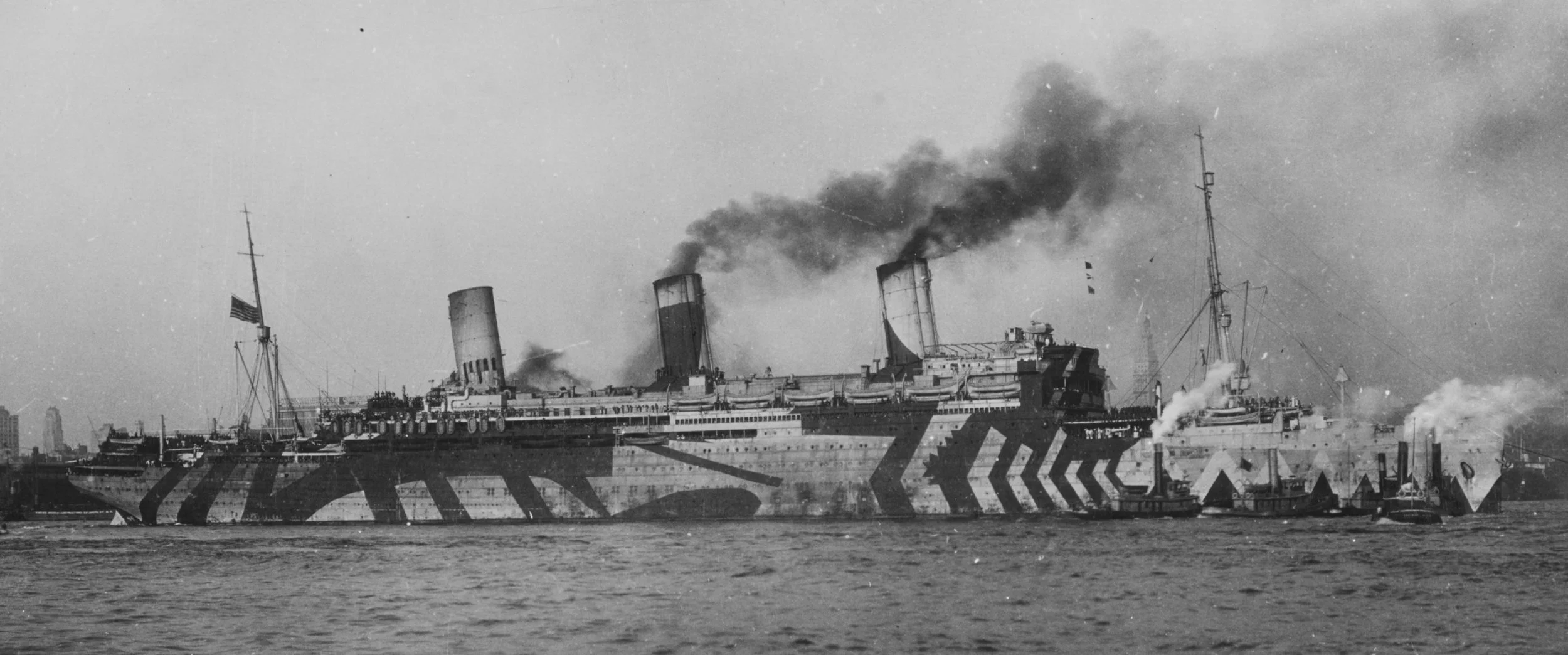
USS Leviathan
The 32nd “Red Arrow” Division began its journey to the Western Front in January and February 1918. In combat, it would be a game-changer. Formed from the Michigan and Wisconsin National Guard, the division would play a leading role in cracking one of the most vital strongpoints in Germany’s Hindenberg Line, and pave the way to victory. The French would designate the Michigan and Wisconsin doughboys, “Les Terribles.” First, though, the Red Arrow had to pass through a gantlet of fire.
Bunker Haan
The Red Arrow trained at Camp MacArthur near Waco, Texas. The men from Michigan and Wisconsin did not get on well together at first, and exchanged taunts and a few fisticuffs before they learned to cooperate. Their commander, General William G. Haan, was a West Point graduate from Crown Point, Indiana. His stubbornness earned him the nickname “Bunker Haan.” The son of German immigrants to the United States, Haan was a no-nonsense type of officer; but he also stood out for his dedication to the welfare of his men. He thought his job was not to bully subordinates, but to give his doughboys the physical and moral tools they needed to beat the enemy.
Call to Action
Haan’s men began departing Camp MacArthur in early January 1918 for the trip overseas. They were broken up into several detachments that boarded ships at port facilities in New York and New Jersey. The first group sailed on January 13. In the weeks that followed, others embarked on American transports named the George Washington, Martha Washington, President Grant, President Lincoln. The unlucky, including engineers, medics, military police and other support personnel, climbed on board the British transport SS Tuscania.
Tragedy
The Tuscania was near its destination—Liverpool—on the night of February 5 when a German U-Boat torpedoed it off the coast of Scotland. Most of the troops were asleep at the time, but they behaved admirably under pressure, following drill as they worked their way onto the deck and the waiting lifeboats. But time was short, and just over two hundred Americans were either killed in the initial explosion or drowned before they could reach safety. A monument on the Scottish island of Islay still commemorates their sacrifice.
The Leviathan
The Tuscania’s fate occupied the minds of many Red Arrow soldiers one month later when some 8,242 of them boarded the USS Leviathan. This gigantic ship had once been the Vaterland of Germany’s Hamburg-America Line before it was confiscated upon American entry into the war. Despite its size, the ship was crammed nearly to bursting with American troops—officers on the top two decks, and men mashed into the lower decks with their massive canvas packs. To move to and fro, they had to squeeze through aisles only eighteen inches wide. There was next to no ventilation.
A juicier target for German U-Boats was hard to imagine. A single torpedo hit would doom thousands of men.
This was the Leviathan’s second journey across the Atlantic as a troop ship. On its first visit to Liverpool in February, it had “been camouflaged in a most queer design by English experts, which made it appear more grotesque than ever.” Even with the camouflage, however, the crew and Red Arrow passengers worried about U-Boats.
A Close Call
The Leviathan departed New York Harbor on March 4, making a steady speed of twenty knots. Each doughboy was given a life vest, and abandon ship drills filled the days. At night the ship was kept dark except for a few small blue “battle lights” at doorways. The mood on board was tense. Ship crew, concerned not just with U-Boats but with the possibility of sabotage—many Red Arrow doughboys had German heritage—guarded the ship tightly. One doughboy was arrested and thrown in the brig for “seditious remarks.”
The ship entered the war zone—known to be infested with submarines—on March 11 as it made a zigzag course for Liverpool amid a screen of escort destroyers. Hours later the doughboys got the fright of their lives when an explosion shook the Leviathan “from stem to stern.” Minutes passed before they realized that the destroyer Manly had sighted a suspicious object and dropped depth charges just 800 yards from the Leviathan; the escort ship also fired its five-inch batteries as it dashed about frantically. But no U-Boat was sighted, and the Leviathan sailed on unhurt.
The doughboys heaved a collective sigh of relief as the Leviathan pulled into Liverpool dock on March 12, 1918. As they debarked, many expected some sort of reward for what they had endured—at least a hearty meal? Instead, they received a humble repast of bread, cheese and tea. In disgust, they named their first camp on British soil “Camp Cheese.”
A few months later the Red Arrow entered combat and made its mark. The Leviathan, meanwhile, continued its trans-Atlantic duties as a troop ship, and emerged from the war unscathed. On December 16, 1918, the ship returned triumphantly to New York City carrying thousands of victorious doughboys. Among the passengers: outfielder Ty Cobb of baseball’s Detroit Tigers, who had served in the U.S. Army’s Chemical Corps.