Night Bombing in Handley-Page Aircraft, 1917-1918: Great War Memoirs, Short Reviews
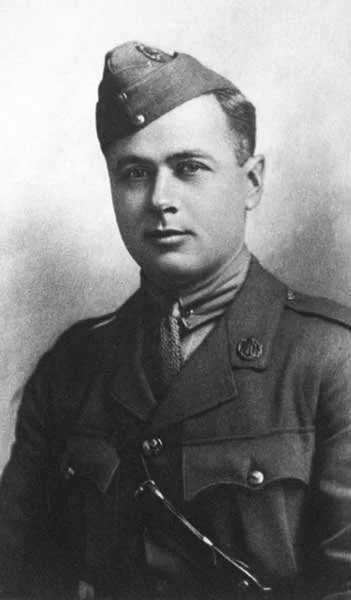
Lt. Robert H. Reece (from the book)
A Review of Night Bombing with the Bedouins, by Robert H. Reece (1919)
Not every World War I memoir that one reads need be big and profound. Sometimes a short, slice of life piece can add a little perspective to a larger impression of how people experienced the conflict of 1914-1918. Such a piece is Night Bombing with the Bedouins by Robert H. Reece, published by Houghton Mifflin in 1919. At only about 100 pages, it’s a quick, mildly informative and entertaining read about a lesser-known aspect of aerial combat during the Great War.
Forgivably, one might assume from the title that this book chronicles fighting in the Middle East. In fact, it’s an account by an American flier in a multinational but officially British squadron of Handley-Page bombers assigned to flying night missions over Germany and along the Western Front in 1917-1918. Google’s AI search feature will helpfully (?) inform you, having stolen content from this open-source book available at Open Library and Project Gutenberg, that the Bedouin Squadron was so named for having been moved from place to place along the front. But that’s from Reece’s own description, and I do not know the actual squadron designation, which he does not supply (I welcome enlightenment from better-informed readers).
Reece provides only brief glimpses of his own experiences, giving instead anecdotal accounts of squadron personnel and their escapades. But if this isn’t properly a memoir (although it is catalogued as such), it isn’t a unit history either, since he doesn’t give dates or many specific locations, and refers to pilots and ground personnel only by nicknames.
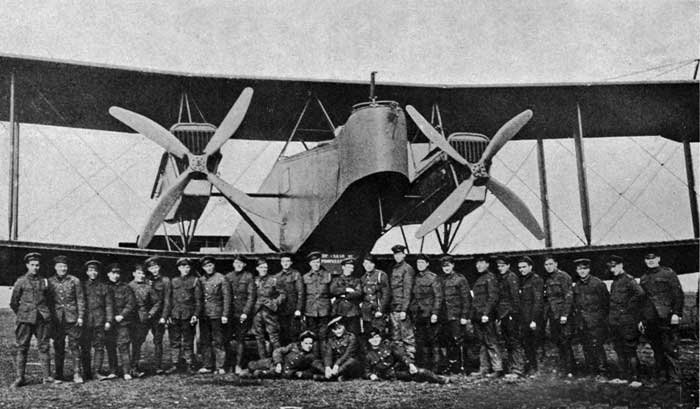
The Squadron with one of their aircraft (from the book)
The Handley-Page
Aviation history enthusiasts will enjoy reading Reece’s descriptions of flying the British Handley-Page bomber in night bombing missions. German zeppelins and Gotha bombers were altogether more destructive during World War I, and aviation experts (which I am not) seem to regard the Handley-Page as somewhat inferior to its counterparts. Reece does not dwell on the British bomber’s drawbacks, or treats them humorously; and he tends to exaggerate the impact of both strategic and tactical bombing efforts. For example, in comments reminiscent of American “Billy” Mitchell’s grossly inflated claims about strategic bombing that I decried in my book To Conquer Hell: The Meuse-Argonne, 1918, Reece insists that his squadron simply obliterated a German brigade-sized reinforcement moving toward the front overnight during the Battle of Passchendaele. Interestingly, Reece is also at pains to insist that his squadron concentrated solely on military targets, which the Germans certainly did not.
For all that, Reece’s description of the personal experience and cost of these bombing raids is quite fascinating. They could last up to nine hours out and back, and were vulnerable to friendly fire incidents as well as the surprisingly complex and effective anti-bomber measures the Germans implemented around their factories. Reece’s description of British methods for signaling and navigation may also prove of interest to readers. As I said, this is a book for an hour or two’s diversion, but reasonably worthy for all that. My Goodreads rating: three stars out of five.