Insurgency Leadership, an Epochal War: Lions of the Atlas
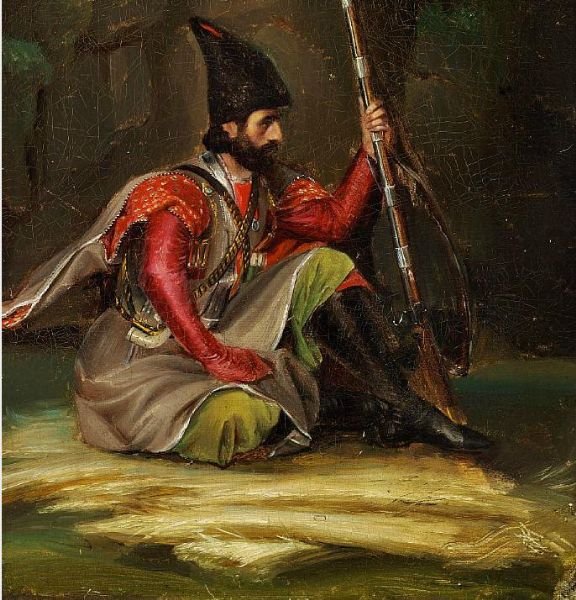
Martinus Rorbye, A Seated Kabyle (Wikimedia Commons)
My upcoming book Lions of the Atlas: France’s Wars for Empire and Resistance in North Africa, 1827-1934, is the most comprehensive military history of these conflicts ever published in English, and the first such work to be written in any language for over a century. In my chronicle of these fascinating battles and campaigns, I’ve been particularly keen on evaluating military leaders in terms not just of raw tactical ability, but of principles of character and leadership. In a previous blog post, I took a look at French Marshal Bertrand Clauzel. I’ll now evaluate an almost entirely forgotten, but highly competent and successful Algerian resistance leader.
As a historian who has studied the American Revolutionary War (although my degrees are in European history), I’ve become used to thinking of “insurgency” (for lack of a better word) leaders in terms of eighteenth-century, European-style warfare. More recently, westerners like myself tend to look to charismatic (for good or ill) twentieth and twenty-first century leaders such as Castro, Mao, Ho Chi Minh, or Osama Bin Laden, among many others.
It was (leaving aside Spain’s effective but relatively brief guerrilla war against Napoleon’s armies in about 1808-1812, and the long, complex and in many ways unique 18th-19th century wars in the Indian subcontinent) the conflict in Algeria in the 1830s and 1840s that really defined insurgency and counterinsurgency as the modern world understands it. These wars don’t lend themselves well to stereotype and simplistic analysis; they didn’t reduce simply to ponderous French columns fighting European style against light, mobile Arab cavalry employing maneuver, small unit action and long-range sniping. In fact, North Africans (whether Turkish, Arab, or others) often sought to employ traditional European methods against irregular French forces.
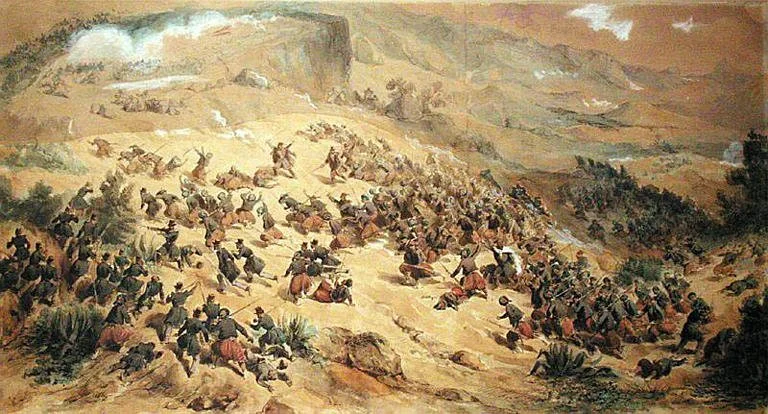
Battle on the Teniah Mouzaia, 1840 (Wikimedia Commons)
Mohamed Ben Zamoun
The best-known resistance leader, the Algerian Arab Abd-el-Kader, about whom I’ll blog separately, veered between employing traditional North African and modern European methods of warfare. If I may be excused for making the comparison, he was a lot like George Washington in believing that the best way to defeat would-be colonial overlords was to use their own methods against them. In the end, though, Abd-el-Kader’s efforts failed despite his exceptional leadership ability.
Far more effective was a man named Mohamed Ben Zamoum (Zamoun), a marabout (a tribal political and military leader of outstanding, even holy virtue) of the Algerian Kabyles. A branch of an ancient North African people who had lived there long before the Arabs arrived, known in ancient times as Numidians and later Berbers (a pejorative unfortunately lacking an effective alternative), the Kabyles were warlike, tough, and extremely canny. Their resistance to French colonial armies was potent and far more successful than that of any others—indeed their cousins, the Moroccan Rifs, would still be fighting the French over a century after the initial European landing near Algiers in 1830.
I’d never heard of Zamoum before I began writing Lions of the Atlas, but he popped up so often in primary sources that I couldn’t help but take notice. Born apparently in 1795 and so in his mid-thirties when the French captured Algiers in the spring of 1830, Zamoum, as leader of a Kabyle tribal coalition, earnestly attempted to convince French Marshal Bourmont to stay in Algiers, take what he would, and go home. When Bourmont ignored this wise advice and pushed south to the town of Blida in the summer of 1830, Zamoum roused his people and sent the French scurrying back to Algiers.
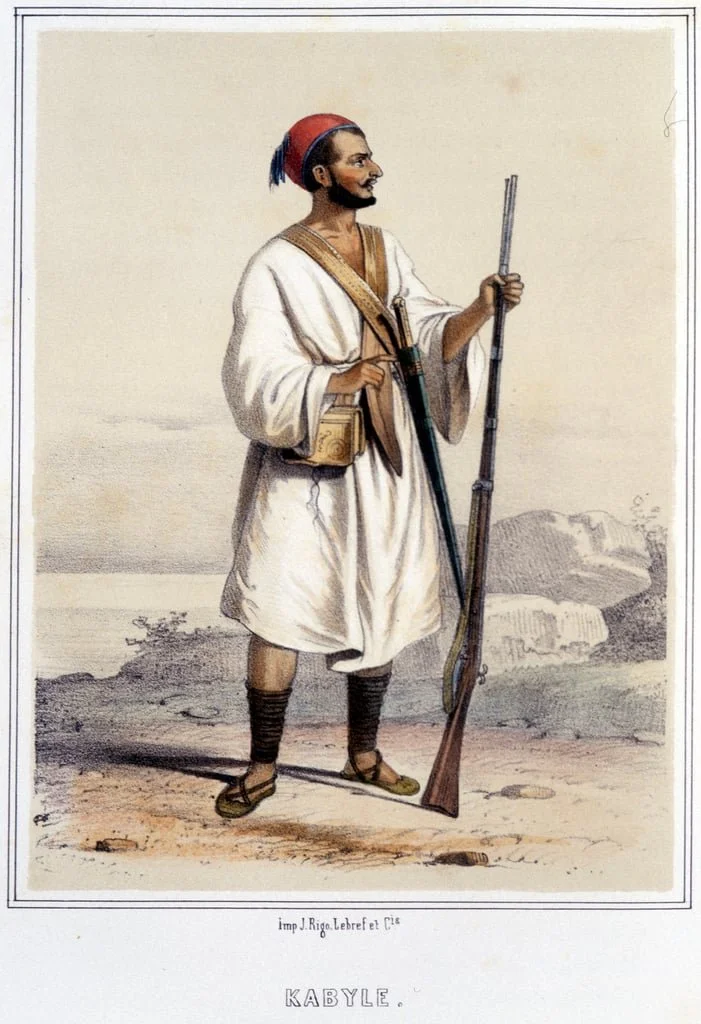
A Kabyle Fighter (Wikimedia Commons)
A Charismatic Shadow
Over the following years, Zamoum became the primary adversary of Bourmont’s successors, especially Clauzel. No image from life of Zamoum is known to exist, nor any significant descriptions of his personality. He didn’t interact much with the French, wasn’t flamboyant, and operated on foot rather than horseback; so he never achieved the celebrity in the west that Abd-el-Kader would enjoy. In mountains, hills, plains, and along Algeria’s coast from 1830-1837, however, Zamoum (who died in 1843) repeatedly engaged and defeated or at least stymied the French. His charisma was such that men would follow him anywhere, without question.
Zamoum’s preferred tactics weren’t exactly small unit, or hit and run. He capitalized on Kabyles’ knowledge of Algerian hill and mountain terrain to move quickly, appear where the French least expected, and then to melt away when the odds turned against him. Yet Zamoum wasn’t afraid to marshal large forces, or to engage the French main force when the opportunity presented. Recognizing the superiority of French firepower, Zamoum attacked when his fighters could advance quickly to close quarters, hit the enemy where they were most vulnerable (especially at mid-column) and count on the Kabyles’ sturdiness and ferocity to prevail.
So it was, for example, that at a place called the Mouzaïa Pass in the Atlas Mountains south of Algiers in November 1831, Zamoum’s Kabyles suddenly attacked and nearly annihilated a strong French force under Clauzel in a battle that I describe in detail inLions of the Atlas. Over the following years, unlike Abd-el-Kader, Zamoum would fight the French often and never be defeated; and his methods would inspire Algerian and Moroccan resistance leaders well into the twentieth century—and arguably, although Zamoum himself is now forgotten, well beyond and outside North Africa.
Lions of the Atlas is available for preorder now, and for purchase on October 29, 2026!