Creating in a World Obsessed with Boring and Stupid AI: An Author’s Thoughts

Medieval Writing Desk (Wikimedia Commons)
I’ve blogged recently here about deplorable recent trends to feed historical documents and catalogs into the AI colossus, and to attempt to replicate historical figures by synthetic means.
Honestly, though, I don’t think about AI very much. It’s just boring and stupid. Whatever its possible applications in fields other than my own, and irrespective of the frenzied adulation, portentous whispers, and histrionic fear-mongering (much of it manufactured by AI touts), this technology looks worthless me and I’m happy just to sail on, ignoring it, reading and writing as I have always done. Echoing art historian Sir Kenneth Clark, and without shame, “I now reveal myself in my true colors, as a stick-in-the-mud.”
It’s worth asking anyway, whether AI really changes human creativity’s dynamics. The true “God-given works of genius” as Clark called them in his TV series Civilisation, in art, writing, and every other medium, have always emerged from a sea of mediocrity—and AI, at best, can never transcend mediocrity. It can’t begin to challenge inspired creativity.
However, it is true that AI’s backers are inflicting tremendous harm on people and society. Too many bosses are forcing early and mid-career employees’ heads under the scummy AI pond’s surface, or using this junk technology as an excuse to cut costs by firing talented people. All that’s to say nothing of the pestiferous data centers, the reduction of history to AI slop, and more.
So, I’m going to offer a few ruminations—albeit, sadly, no lasting solutions—here for creatives, especially writers, researchers, and readers, in this toxic era. Then, henceforward, I’ll turn my attention to pleasanter pursuits.
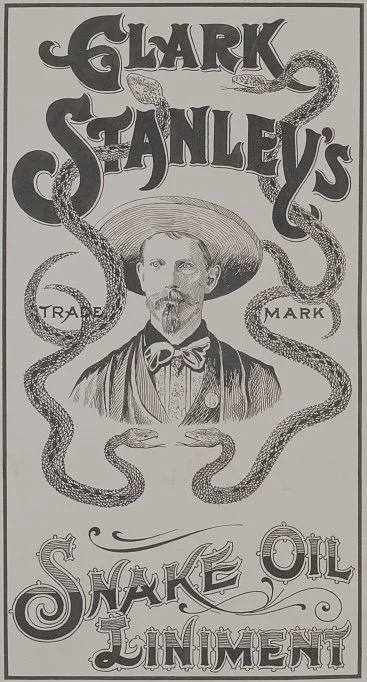
Clark Stanley Snake Oil Ad (Library of Congress)
The Con Game
Others have written at length about the Large Language Model’s deep and irremediable flaws, especially as applied to the arts and humanities, so I won’t repeat their observations here. As I’ve stated before, though, it should be obvious that tech companies and corporations, along with smaller entities that have bought into their con, have invested so much in this technology that they can’t afford for it to fail. Their resources are infinite—for now—and they’re going all-in to change human behavior on a massive scale. It’s a massive gamble on their part, but they think they can pull it off before the bubble pops.
These days, it’s practically impossible to open a computer or write anything, from papers and social media posts to emails, without being prompted to rewrite with AI, or to select an AI-generated text without composing anything yourself. And teachers and scholars are complaining about students submitting AI-generated papers? Get real; you’re in a war with the big guys. Big tech very much wants everyone, including children and students, to abandon their own composition in favor of AI. Corporations want to rewire human behavior from an early age to induce dependency and ensure continued and growing returns on investment over the longer term. For reference, just look at the behavior of big tobacco and pharma, as well as producers of smart phones, social media, and streaming services, over the past decades, all of which deliberately aspired to induce dependence and manipulate popular habits. There’s no conspiracy-mongering in pointing out this standard corporate practice.
Also, keep in mind that with their infinite financial resources, the AI hucksters have hired and are hiring the largest marketing firms and most talented people available to saturate social media and indeed all media with AI hype. These are clever professionals, and they’re not just crowing about AI; more recently, they are introducing content that begins by seeming to critique AI, before insinuating suggestions that AI slopping is just “misuse,” or that AI can be used “responsibly” by smart people. Of course, they will tell you—smart person that you are—how to turn your mind over to the AI Bot correctly. They’ll tell you AI—like, say, a highly addictive sedative—is a “tool” that can be used or misused, instead of actually being what it is: a toy that’s good for nothing.
Likewise, in the midst of all the recent buzz about anti-AI public sentiment, I’ve noticed newspaper articles appearing about, for example, AI being used to save endangered species, or helping young people find jobs, and so on. I doubt any of these obvious planted puff pieces will bear serious scrutiny, but expect more of the same. It’s all a palpable effort to change the public narrative. The AI hucksters are aware of the negative press, and they will subject us all to an avalanche of marketing before they give up.
For authors, accepting the marketers’ pitch means, allegedly, just using AI for certain things, while keeping your mind and creativity free. The key to the pitch’s success is not to let you recognize that, in fact, AI is worse than junk in every respect and that you’re far better off disengaging with it. You wouldn’t want to be shamed as a “refuser,” or a Luddite, would you? You wouldn’t want to be . . . “othered” in a society subsumed in AI slop.
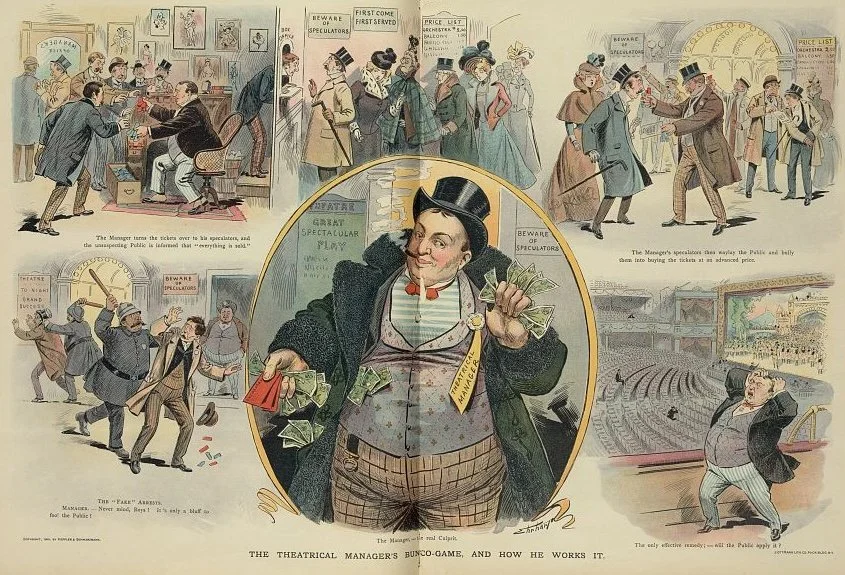
The Theatrical Manager’s Bunco Game (Library of Congress)—not dissimilar to corporate strategy on AI, and the only remedy . . . not showing up.
The Scam
Being a committed and happy Other and Refuser as I am, I really don’t notice AI idiocy except in the flood of AI-written scams targeted at authors—and recently even crafted on a couple of occasions to bait me specifically—filling up my email inbox. If you’re a writer, you’ve received them too: asking “permission” to review your book, urging you to speak to a book club, offering help to market your book, or impersonating trade book editors or literary agents. There’s a particular malevolence and vindictiveness in this kind of scam that seeks to victimize aspiring authors that I find especially creepy, but I suppose there’s nothing really shocking about it in a world full of human parasites who seek to utilize new technologies to victimize children, women, minorities, and the elderly. And AI is, if nothing else, handy for producing scams on an industrial scale.
I also run into AI when, scrolling social media (which I try to do as little as possible) I run across someone who has used AI to create images or movies of historical events, and gushes about its “authenticity.” Well bless my soul, I generally can’t help calling this out for the crud that it is. But I’m fully aware that it’s a flood, and all I’m seeing are the puddles.
More generally, I know that much of my copyrighted work has been stolen to train AI, and that surely this blog, like everything else online, is being assiduously scraped for the same purpose (why, then, are AI bots still almost always wrong most of the time?)
All these things are annoying. More infuriating is when I see friends and younger professionals with tremendous creativity and promise losing their jobs and career prospects because of a junk technology that doesn’t work.

Sculpture (Library of Congress)
Tuning Out
Timothy Leary told the 1960s to “turn on, tune in, drop out.” The better approach now might be to turn off and tune out. I’m lucky—I’ve reached the point in my career when I can follow my own creative whims (and sometimes chimeras or demons) and tune out from the idiocy surrounding me. As an old wargamer, I can remember all the chatter back in the 1980s about how AI was going to make gaming, and eventually human thought, irrelevant, since computer opponents were almost impossible to beat at chess. As it turned out, though, at practically any other game, computers almost always were laughably easy to beat by humans employing the unorthodox, unexpected, and supposedly irrational—or as Captain James T. Kirk did in his Starfleet Academy exam, changing the rules of the game. I haven’t seen any indication that the bots of today can do any better.
I’m not really worried about trying to “prove” my writing isn’t AI, since anyone who knows me realizes I wouldn’t have the first idea how to edit or compose with the help of some chatbot. I’ll keep on using em-dashes, thank you very much. As a voracious reader, I also don’t care about the inevitable rise of AI-influenced or composed writing, since I rarely read any fiction published after about 1990, and am selective about the nonfiction I read. AI can effectively imitate uncreative, mediocre writing, but that stuff always turned me off anyway even when humans concocted it.
Concluding this rambling rumination: my advice to authors and readers like myself would be to abstain from and ignore AI entirely—not as something horrible and frightening, but as something crass and stupid.
Maybe more to the point, I’m quite sure that contempt and derision are better weapons against AI stooges, than fear and hatred. Their stock response to anger is to say, “you’re just afraid of this awesome technology which will supplant human intelligence and take over the world. You’re a caveman, get with the times.” Contempt and laughter, though, is something they can’t cope with—it symbolizes the threat of exposing their technology as the tripe it is. And let’s face it, AI art and writing is laughably bad. Mocking AI, as something that smart people don’t waste time with, seems beneficial to me.
That’s cold comfort, I know, to younger folks, Millennials or Gen Z or whoever follows—but I’ve been heartened to see the growing defiance among those who have to face AI garbage every day and see it changing their world. For their and my children’s sake, I hope talented people continue to resist the corporate bum rush toward conformity—and that they soon find the wherewithal to expose AI as junk technology and reclaim their future.
As for me, I’ll just close the shades, turn on my night-table lamp, settle in my easy chair with a glass of wine, and crack open another Robert E. Howard, Raymond Chandler, P.G. Wodehouse, or Arthur Conan Doyle. Then I’ll open my laptop and do some random scribbling—very far from genius quality, but it’s what I do. Goodnight, folks.