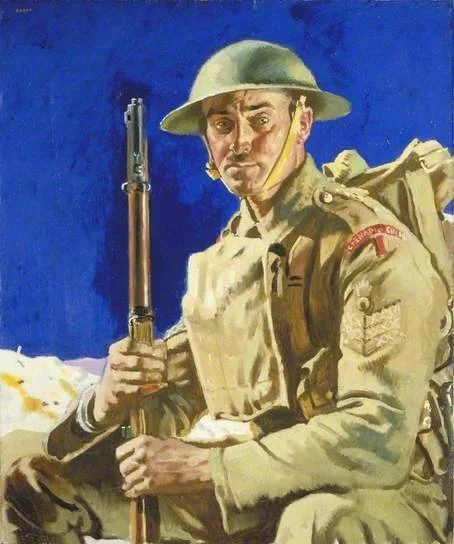
A Grenadier Guardsman, by Sir William Orpen, 1917 (Imperial War Museums)
Reviewing Reminiscences of a Grenadier, by E.R.M. Fryer (1921)
“Everyone knows how the war started; if they don’t, it is through their own idleness.” So begins Reminiscences of a Grenadier, 1914-1919, by E.R.M. Fryer; and certainly it is as original an opening as you’ll find in the genre. Likewise, Fryer’s confession on page 2, “Whether it was boredom or patriotism that drove me into the Army I don’t know.”
A public school lad from Eton—he attended annual Old Etonian dinners with other officers throughout the war—Evelyn Ronald Moncrieff Fryer (1889-1967) entered service in September 1914 with the Honourable Artillery Company (like Walter Gardner, whose memoir One Mole Rampant I have reviewed previously). Fryer served with the unit’s No. 2 Company, and provides interesting descriptions of the unit’s baptism of fire near Kemmel in November of that year, witnessing for the first time the realities of industrialized warfare. Fryer’s descriptions manage to be revealing and self-deprecating at the same time: “I thought I was going all right, though not exactly enjoying life, until I was ordered to get out of my seat in the slime, and help carry in the rations, and then my legs quite failed to function, and I sat gracefully down in the mud and stayed there.”
Thus far, to the beginning of 1915, Fryer’s narrative ranks among the better accounts of the early months of trench warfare on the western front, as he writes frankly of his own thoughts and experiences, and of the men alongside whom he fought. Then, in the spring of 1915, he was commissioned in the Grenadier Guards, the famed unit with which he would serve through to the war’s end.
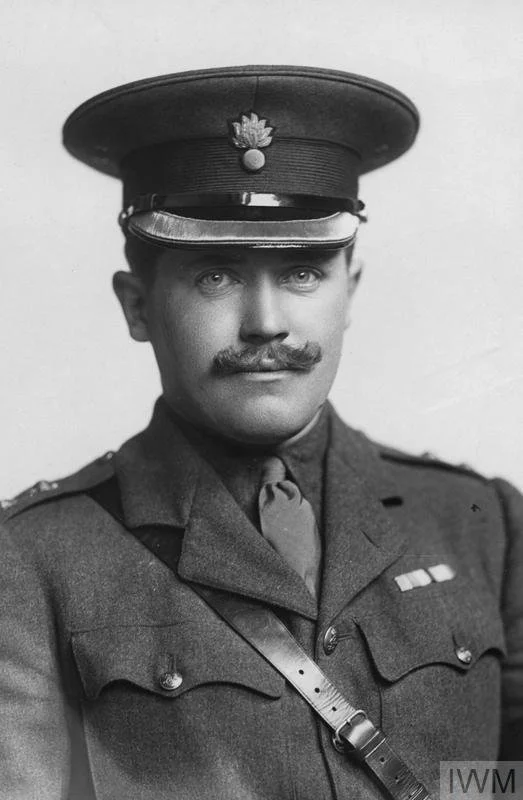
Maj. E.R.M. Fryer, M.C. (Imperial War Museums)
The Unspoken—and the Unspeakable
Fryer became a lieutenant in the 2nd Battalion (transferring later in 1915 to the 3rd Battalion), Grenadier Guards, which soon became part of the Guards Division along with the Irish, Scots, and Coldstream Guards. He saw intense combat at the Hohenzollern Redoubt in October of that year, and then at Ypres and on the Somme in 1916, where he was wounded. “My wound was nothing really, and soon healed,” Fryer writes; and this is typical of his self-deprecating style, fitting the English officers’ ethos. The reader is left with no sense of how, evidently, he led from the front and earned the respect of fellow officers and men.
Indeed, from 1916, Fryer seems to lose interest—or more likely, ability—to describe the onward procession of events, and one battle to the next. By the book’s latter third he recounts them dryly, in the style of a diary or unit history. The clearest indication of the severity of the fighting he witnessed comes from his careful listing of the officers under and with whom he served, and how most of them were—including the Prime Minister’s son, Raymond Asquith—killed and wounded in quick succession. At the beginning of the Battle of 3rd Ypres, or Passchendaele, Fryer earned the Military Cross for leading his company—which took over 50% casualties—in assaults on German pillboxes.
After almost three years of continuous combat service, Fryer was detailed to home service from the end of 1917 until the spring of 1918, and so avoided the German 1918 offensive, but participated in the British offensive known as the Hundred Days from August to November 1918 that played such a critical role in defeating Germany.
Sadly for the modern reader, Fryer’s narrative remains tight-lipped until the very end. One has the sense, which Fryer hints at, that his experiences were just too much for the printed page, and perhaps his mind, to encompass fully. And so it appears he took refuge in the simple recounting of movements and events—needing to write about it, but like the vast majority of his fellow veterans unwilling or unable to reveal his true feelings. My Goodreads rating: three stars out of five.