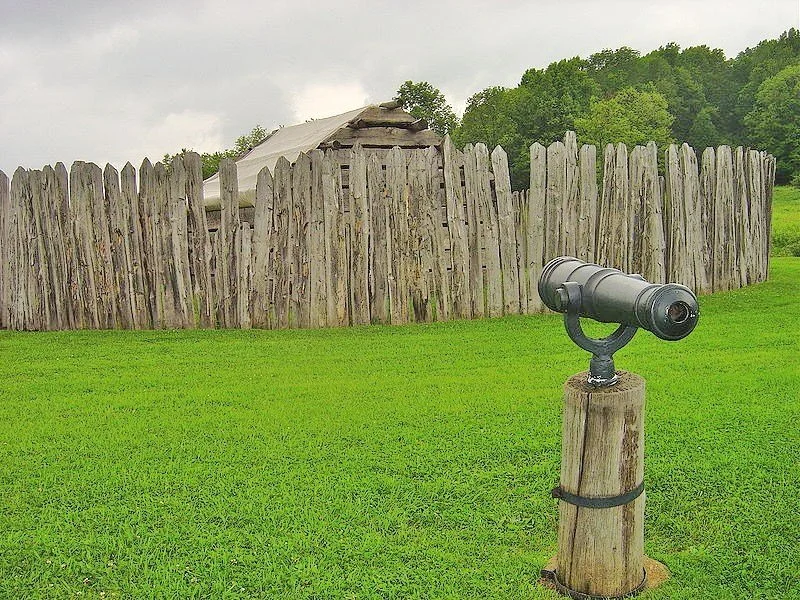
Fort Necessity (Wikimedia Commons)
George Washington was not usually prone to nostalgia or reminiscences. Still, as a combat veteran now holding, as Commander in Chief of the Continental Army, the fate of the young United States in his hands, he could not help thinking back to his first experiences of battle even as he faced imminent battle with a British invasion force at New York City.
On July 20, 1776, then, he wrote to his old comrade Adam Stephen, a general in the Continental Army who had shared with Washington the French and Indian War battles at Fort Necessity and the Monongahela River on July 3, 1754, and July 9, 1755. “I did not let the Anniversary of the 3d or 9th of this [month] pass,” Washington wrote, “without a grateful remembrance of the escape we had at the Meadows and on the Banks of Monongahela. The same Provedence that protected us upon those occasions will, I hope, continue his Mercies, and make us happy Instruments in restoring Peace & liberty to this once favour’d, but now distressed Country.”
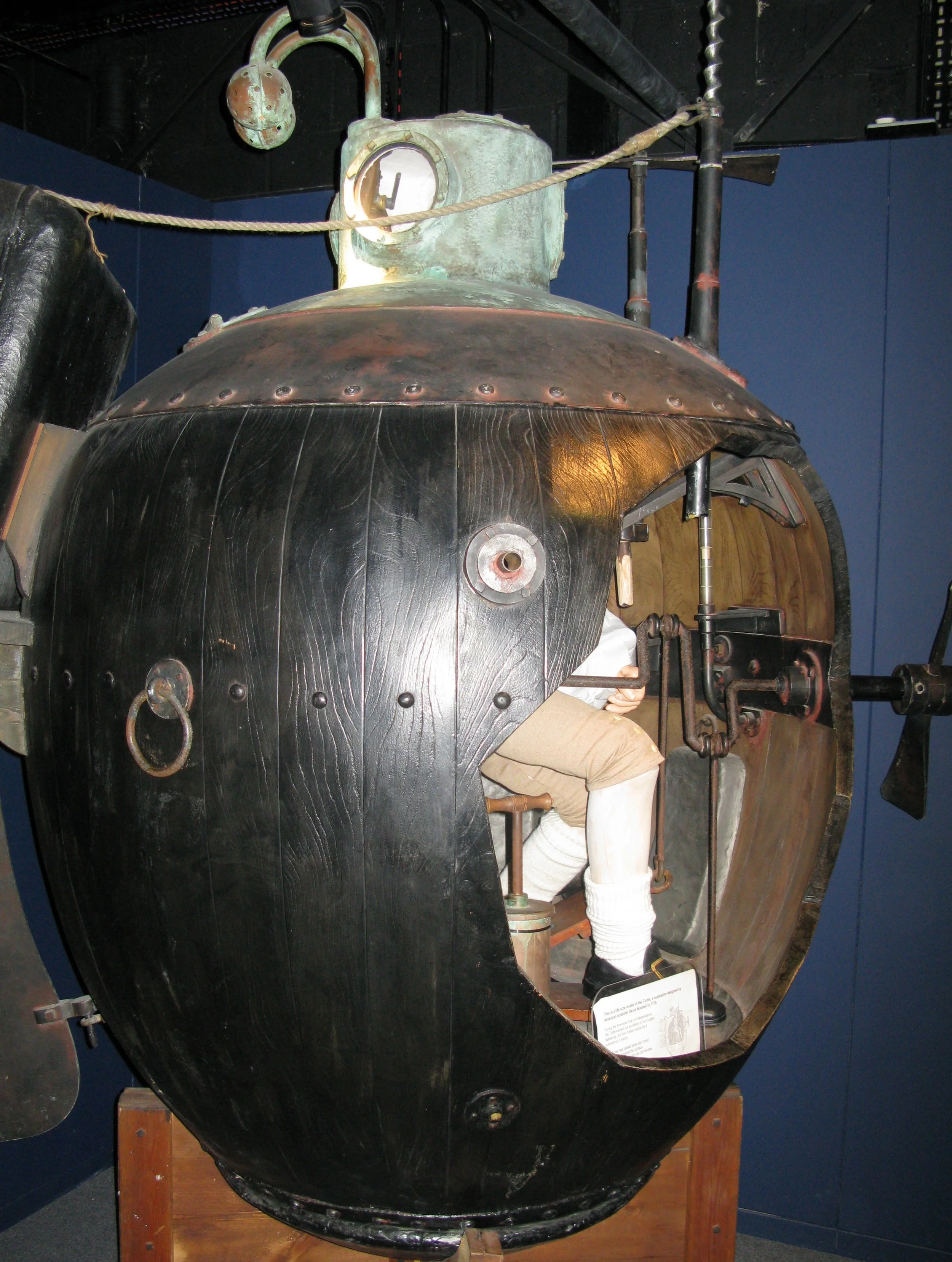
A replica of David Bushnell’s “Turtle” submarine (Wikimedia Commons)
Inventing Submarines
Two days later, Benjamin Franklin wrote to Washington from Philadelphia about Joseph Belton, a Connecticut inventor who had been trying without success to get Congress to pay attention to his ideas for constructing an experimental submarine that could be used against the British fleet. Belton had “petitioned the Congress for Encouragement to destroy the Enemy’s Ships of War by some Contrivances of his Invention,” Franklin wrote, but “they appear to have no great Opinion of such Proposals.” Franklin therefore recommended Washington to support Belton’s desire to “work intirely at his own Expence” to launch a submarine attack on the British warships on the Hudson River near New York City.
Belton had proclaimed his efforts to “make a Machine by the help of which, I will carry a loaded cannon, two or three miles up or down any of our harbours without any other assistance, and all the way there should nothing appear above the surface much larger than a man’s hat . . . my Machine, would wholely descend under warter for some time, and by expanding, would rise to the surface at pleasure, and by this means, to avoid any discovery when I had arrived within an hundred and fifty, or two hundred yards of a Ship, I could descend under the surface, and go along side of her bottom against which, I could discharge the Cannon, that should be prov’d large enough to send a ball through any ships side.”
Washington, always supportive of technological innovations whether in agriculture, industry or warfare, eagerly supported Belton’s experiments, although they never came to fruition. Soon, though, another inventor named David Bushnell would surpass Belton’s efforts to construct America’s first submarine. He would name his submersible the Turtle.
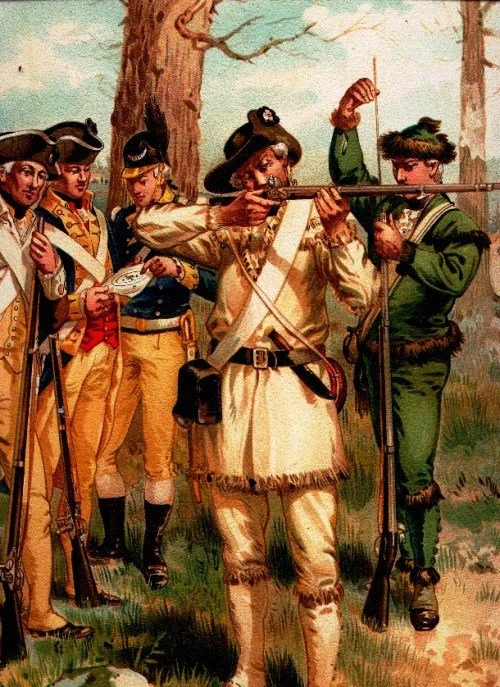
Continental Army, Miscellaneous Organizations, by Henry Ogden (US Army)
Military Fashion Choices that “carry no small terror to the enemy”
Meanwhile, Washington—perhaps thinking back to his French and Indian War days—offered his troops some military fashion advice in favor of hunting shirts—which he felt confident would intimidate the British. “The General,” he proclaimed on July 24, “being sensible of the difficulty, and expence of providing Cloaths, of almost any kind, for the Troops, feels an unwillingness to recommend, much more to order, any kind of Uniform, but as it is absolutely necessary that men should have Cloaths and appear decent and tight, he earnestly encourages the use of Hunting Shirts, with long Breeches, made of the same Cloth, Gaiter fashion about the Legs, to all those yet unprovided. No Dress can be had cheaper, nor more convenient, as the Wearer may be cool in warm weather, and warm in cool weather by putting on under-Cloaths which will not change the outward dress, Winter or Summer—Besides which it is a dress justly supposed to carry no small terror to the enemy, who think every such person a complete marksman.”