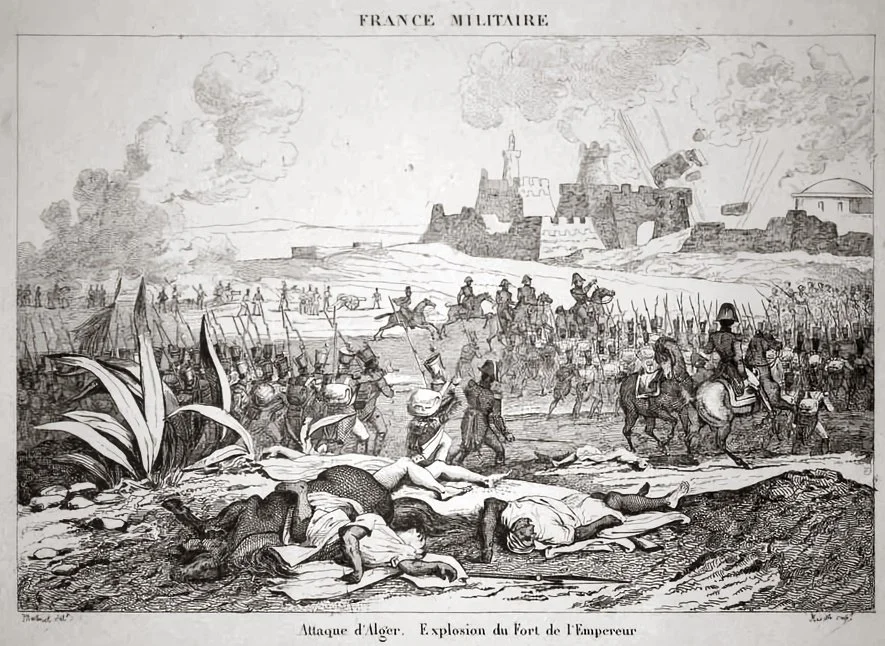
Attaque d’Alger (Wikimedia Commons)
Since landing at the sandy peninsula of Sidi-Ferruch on June 14, 1830, the French expeditionary army invading the Regency of Algiers had steadily fought its way eastward toward Algiers itself, fighting numerous battles against determined Algerian resistance as detailed in my upcoming book, Lions of the Atlas: France’s Wars for Empire and Resistance in North Africa, 1827-1934.
By the beginning of July, the French army, commanded by the competent but widely despised General de Bourmont—betrayer of the Emperor Napoleon—had reached the city’s western outskirts. Here it faced a massive edifice, Fort l’Empereur as the French called it, a seventeenth-century castle manned by a strong Algerian garrison and dozens of heavy artillery pieces. Bourmont elected to take the place under siege, advancing by regular approaches according to traditional siege-craft, until his own guns were ready to open fire, and his infantry prepared to storm the fort. The attack would have an explosive conclusion.
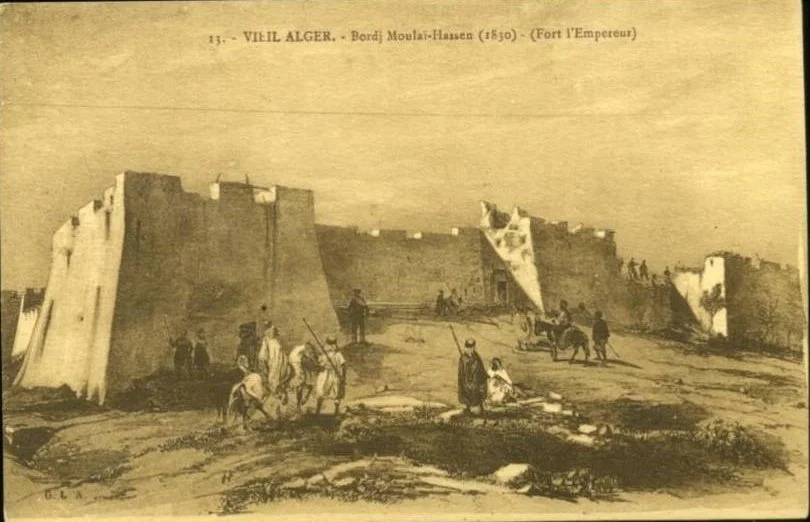
Fort l’Empereur (Wikimedia Commons)
The Battle Begins
At 3:00 in the morning on July 4, 1830, French infantry and artillery crews sat alert in their trenches and emplacements, preparing for the assault on the Emperor’s Fort due to begin at dawn. Suddenly, Turkish janissaries serving the Dey of Algiers—elite infantrymen who had crawled out into the no man’s land between the French trenches and the fort and lain prone all night—leapt up and assaulted some of the French batteries, vaulting through the gun embrasures onto the crews.
Not only were the crewmen awake,, but they were backed by companies of French infantry deployed specifically to repel surprise assaults. The attackers showed not a trace of fear at discovering the odds turned against them. Bayonets clashed with swords, French and Turks fell, slashed, wounded and killed. Finally, the attackers were driven off. Even as they retreated, a signal rocket arced across the sky. Dawn was imminent; the fort’s outline stood against the horizon, and then the embrasures became visible. The bombardment commenced.
Explosions of stone and masonry, and rising clouds of smoke, revealed hits by the French gunners. The defenders rushed quickly to their guns, returning fire for fire.
Smoke, mist, and darkness obscured the scene, with only flashes visible, until a breeze swept in from the east at sunrise—first revealing the fort, and then the French batteries. Improved visibility meant better targets for Frenchmen wielding rampart guns, heavy weapons designed for just this purpose. The rampart gunners picked off Algerian artillery crews in their embrasures. Crumbling masonry merlons exposed the defenders, but men stepped forward to replace those who fell, and directed intense return fire.
The gunners of the Emperor’s Fort returned fire for three hours. By seven o’clock, though, resistance from the Emperor’s Fort had begun to taper off, and within an hour its shattered guns mostly had fallen silent. By nine o’clock only a couple of Algerian gun crews were holding out; but first a trickle, and then a cascade of men absconded from the fort’s rear gates and fled toward the city. French infantry officers prepared to exploit, and order full-scale assault.
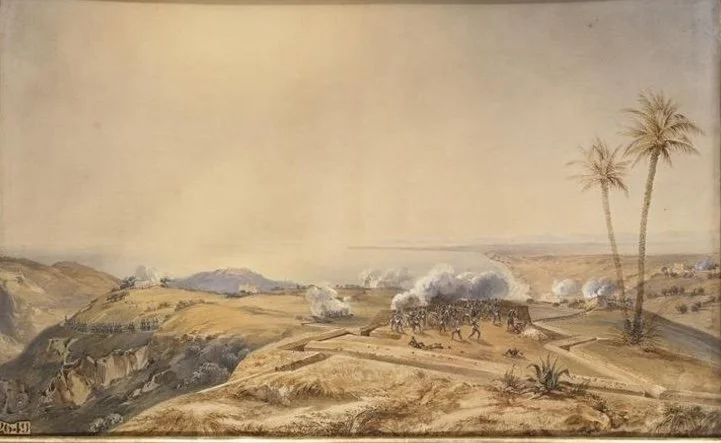
Assault on the Emperor’s Fort (Louvre Museum)
Assault!
A vast detonation shook the ground before the order was given. A pall of black, suffocating smoke enveloped the French trenches and batteries near the fort. Stone, masonry, wooden beams, chunks of scorched wool (used in bales to reinforce the walls), and fragments of metal, dirt, and flesh rained down. The falling debris wounded several French soldiers; everyone was stunned. Minutes passed before the French saw a huge plume rising above the fort. Its central tower was gone, the northwest wall had collapsed. Corpses and body parts lay scattered everywhere.
The first French infantrymen to enter the fort discovered a smoking ruin packed with wreckage and dead bodies. A soldier’s white shirt, improvised as a royal flag and affixed to the crown of a leafless date palm, announced that the Emperor’s Fort belonged to France.
Occupying the fort, repurposing its few surviving guns, and bringing forward their own mobile field pieces, the French artillerists and engineers opened fire on Algeirs’s Casbah and nearby secondary forts. In Algiers, the Dey had declared to his people that he would go down to the last bullet under the Casbah’s ruins rather than submit to the invaders. And in fact, even after the unintended detonation at the Emperor’s Fort, Algerians—mostly Arabs—continued to attack French positions in hopes of penetrating the invaders’ lines of communication and supply. But the Dey’s morale, and indeed of the entire Turkish administration of Algiers, had broken. At 2:00 P.M., with French guns overlooking the now-helpless city, the Dey’s first secretary emerged from Algiers at the head of a delegation bearing a white flag.
Bourmont and his officers thought they had won. But the long war of conquest, and Algerian resistance, had only begun.