AI for Kids! Why Not? What Could Possibly Go Wrong?

A Classroom (Wikimedia Commons)
We’ve all seen the social media slogans. “Banning technology from the classroom doesn’t work.” “Don’t be a luddite.” “Don’t be a fear-monger.” “AI is a tool.” We’ve also all seen those posts, usually with some variation of an AI-generated image of a robot in the “Thinker” pose, looking at a chessboard, with (probably AI-generated) musings purporting to show both sides of the so-called debate over whether AI can think or not.
All the posts and their attached “essays” more or less look the same. And they are usually posted by “personal” profiles sporting images of young, smiling, “attractive” types of people – you know what I mean.
It doesn’t take any kind of genius to recognize that 9 out of 10 of these posts, maybe a higher proportion, are paid marketing. The profiles may or not belong to genuine people, but there’s a reason why they all read pretty much identically: they all originate, at however many steps removed, in the tech giants’ marketing board rooms, as they utilize their limitless financial resources to attempt to manipulate public perceptions.
Don’t tell me I’m conspiracy-mongering. Disguised advertising is as old as the hills, and with the advent of social media, marketers have become extremely proficient at utilizing this newish medium, via “influencers” and others, to meld perceptions. I say with all due respect: these people are pros, and they know what they’re doing.
Recently, I’ve been noticing a new spin, whether in social media posts or in obviously planted articles in big tech-friendly media like the Wall Street Journal (to which I subscribe and for which I write occasional book reviews, though I sometimes consider dumping it). You’ve seen them too: AI saves endangered species! AI identifies Nazi war criminals! AI data centers create jobs! They make everyday Americans rich! AI is vital to national security! Don’t let the Chinese win the AI race! Now why would we be seeing all these “AI is your friend” promotions? Hm. I doubt any of these claims will bear up under scrutiny, but they’re not intended to do so. They are meant, in the aggregate and incrementally, to meld public perceptions.
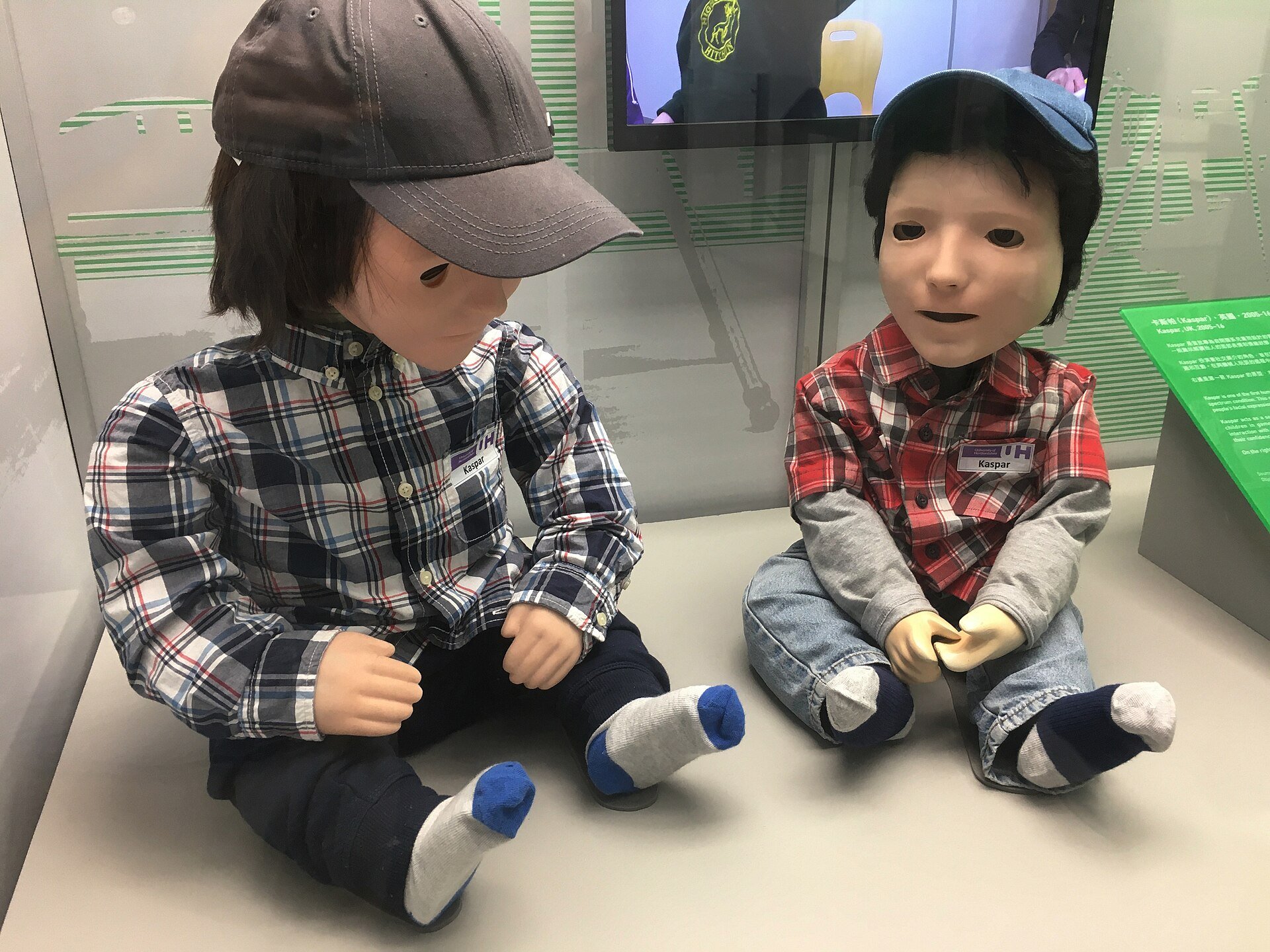
Robot Kids (Wikimedia Commons)
Bots in the Classroom
Perhaps the creepiest of these slogans is “Banning Technology from the Classroom Doesn’t Work.” Right, like keeping smartphones in class is a really great idea; and, some technology is helpful, therefore banning any technology, such as AI, from classrooms is bad. Logic 101? Still, let’s look at this claim for a moment.
Two points up front. First, “Banning Technology from the Classroom Doesn’t Work” is a marketing slogan. An ad making a specific assertion. An as with any promotion, or indeed any assertion, the first thing you need to look at the promoter’s motives, and behavior patterns.
Why does big tech want you to open the door to AI in the classroom? So they can get at your children, and to a lesser extent their educators. Why? Obviously, so that big tech can impress certain habits on forming minds—habits that will carry children through to adulthood. In this case, it’s very clearly intended to make young learners dependent on AI. Don’t tell me it’s anything but dependence: every time you enter MS Word, or write an email or a social media post, the technology urges you to go to the Orwellian AI “Copilot” or its equivalent first; not to assist, but to shape what you are creating. Likewise, there’s a reason Google puts AI results at the very top of any search—it wants users to turn to them first, instead of conducting actual investigation and research.
Now, why would big tech want to foster AI dependence in your children? To guarantee future and ever-increasing profits for big tech. Kids grow up into adults who cannot function without AI: that guarantees big tech’s continued dominance.

Power (Wikimedia Commons)
Past Conduct Predicts Future Behavior
Big tech, including notably the CEO of Anthropic (which, be it said, used pirated copies of my books to train its AI, just as AI bots are even now scraping this blog), has been attempting to generate “buzz” recently with prognostications about how AI will soon become superior to humanity itself. Nonsense. As I’ve said previously, AI itself is not intimidating.
But the people behind it—fed by what Jacob Bronowski once called “the itch for absolute knowledge and power”—are veryintimidating. And not just from the standpoint of the burgeoning tech surveillance state, about which many others have written.
Everyone interested in this subject, and how large companies—whether in tech, pharmaceuticals, or the like—prey upon society, should read two books: Jonathan Haidt’s The Anxious Generation: How the Great Rewiring of Childhood is Causing an Epidemic of Mental Illness, and Patrick Radden Keefe’s Empire of Pain: The Secret History of the Sackler Dynasty. There are also a number of good books about big tobacco.
I particularly like the opening to Haidt’s book, in which he alludes to turning your children over to complete strangers, allowing those strangers to experiment on your kids with untested technologies, driving uncertain but enduring results. Why would anyone do this? And yet it’s what millions of parents have done with their children and social media. Legal victories against Meta notwithstanding, parents continue to passively turn over hours of their kids’ days to Mark Zuckerberg and friends.
The above books provide examples of how large corporations shamelessly manipulate children for profit, seeking to get at them early and induce lifelong addiction, or dependence. This has applied to tobacco, opiods, and social media, with disastrous results. Why should we expect big tech—run by many of the same people who have proven utterly devoid of ethics in the recent past—to behave any differently when it comes to AI?
Twenty years down the road, this will all be “exposed,” but by then the damage will be done—just like the cases with tobacco, opiods, and social media, and I’m sure you could name many more.
And . . . guess who will suffer most from this dynamic? I’m not a progressive (call me a conservative-leaning independent), but the progressive perspective applies here, because it has proven true with tobacco, opiods, and social media: the answer is, the underprivileged will take the brunt. Privileged kids will enjoy enough resources to, hopefully, opt out from the AI behemoth. Underprivileged kids won’t. Their mental development stunted, they’ll be reduced to mental serfdom. And they’ll stay there.

Shields (Wikimedia Commons)
Protect the Kids
I am completely unashamed of being a “Luddite,” although those early opponents of the industrial revolution fought technologies that for the most part, if only in the long term in some cases, actually benefitted society, unlike AI. Yes, it is also true that governments, especially bureaucratic and totalitarian ones, cannot be trusted to act in your or your childrens’ interests. I don’t have a global answer to the AI boom, or bubble, whether through regulation or in whatever form (least of all, violence), although I increasingly suspect—as do growing numbers of jittery investors—that the insane over-investment in AI is heading toward an apocalyptic bust that will make 1929 look like the collapse of a Lego tower.
However, there is no way I am letting AI near my kids. They love reading, crafts, and creation, and they are going to keep on that way. If that means keeping them away from MS Word and Google, so be it; there are alternatives.
And I will also say this: parents, educators, and educational administrators would be crazy to let the tech giants and their AI bots into the classroom. I imagine such enablers pointing toward the kids and saying “go ahead, experiment.” More than that, such willing ciphers to big tech are criminally foolish, negligent—and, sad to say, bought and paid for.
Educators and parents are only just awakening to the fact that big tech is not a partner, or even neutral, when it comes to AI and education. Rather, big tech and their flunkies are palpably malevolent toward wholesome and effective childhood education. The AI hucksters are doing everything possible to undermine efforts to shield children from their technological snake oil; instead, they’re prodding youngsters to become learning and productivity dependent on this AI junk—tangibly, immutably and profoundly inferior to human thought. It’s a massive corporate bum rush.
AI’s deep, elemental flaws and its toxic effects on childhood development and learning are being confirmed through daily usage (which is why investors are so nervous) and innumerable studies. The biggest proof in the pudding, alas, will come a generation from now if, as increasingly appears, we turn our kids over to the corporations—yet again—as guinea pigs. But by then it will be too late.
Public education in the United States, where I live, is in a tailspin and there are many reasons for this growing crisis. Personally, I apportion blame to both the political left and right for this state of affairs. In this fragile situation, the impact of AI will likely be devastating—which is one reason I find it deeply ironic that outlets like the WSJ, which regularly bludgeon (often with good reason) Randi Weingarten’s NEA and its misdeeds on, for example, the COVID lockdown, gushingly tout AI at every opportunity. If big tech, using AI, breaks down the schoolhouse doors, we might as well give up on any hope for progress in education.
The process may be unstoppable. But individually at least we don’t have to be complicit. Quoting Aleksandr Solzhenitsyn: “Even if all is covered by lies, even if all is under their rule, let us resist in the smallest way: Let their rule hold not through me!”