George Washington @ 250: Evacuation Reaction
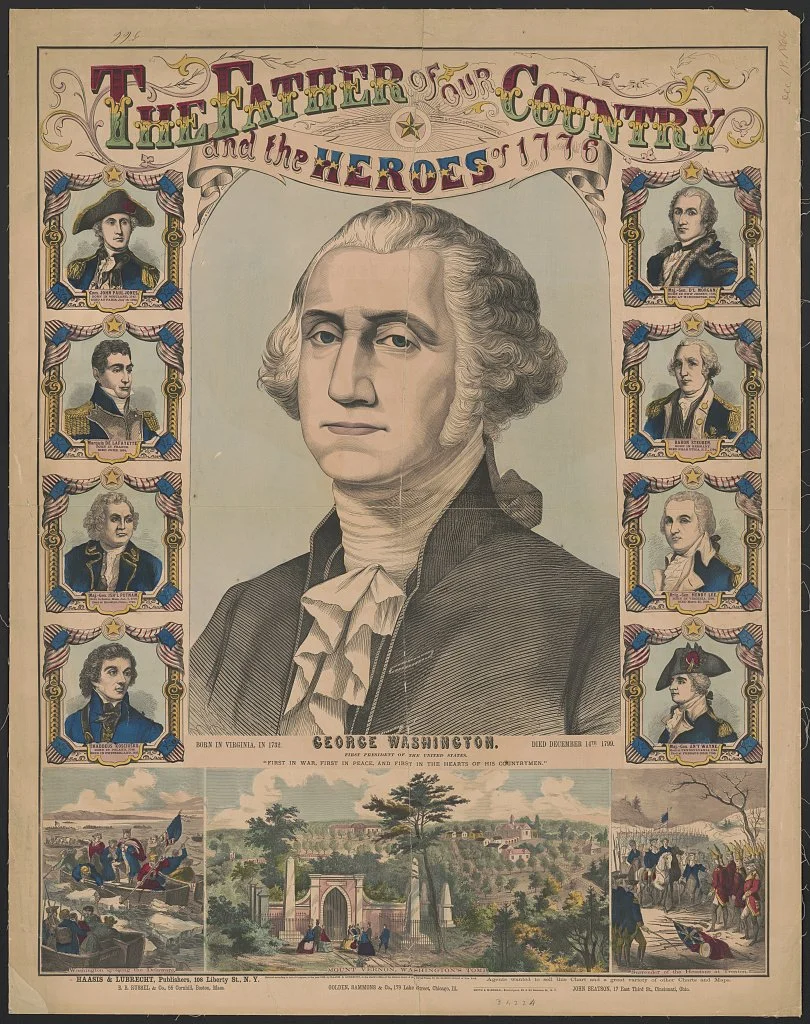
Heroes of 1776 (1866; Library of Congress)
British forces evacuated Boston on March 17, 1776, “evacuation day.” Commander in Chief George Washington, stern-visaged, witnessed the event from his headquarters at Cambridge. There were no huzzahs, clinking glasses, or giddy celebrations—certainly not in his vicinity. He remained all business.
Initially, he allowed hardly anyone to enter the city. There had been reports of smallpox in Boston, so he initially dispatched a detachment of troops who had recovered from the disease and so were immune. Only when Boston was declared free of infection did he send in three regiments of infantry to take possession under the command of General Nathanael Greene. And even then, he declared strictly that only “those who have business there,” and proven residents, should be allowed to enter.
Those who did venture into Boston, moreover, must behave with absolute correctness. Taking a stance that he would maintain throughout the war, Washington would permit no abuse of civilians. On March 21, he issued a proclamation declaring that, “All Officers and Soldiers are hereby ordered to live in the strictest Peace and Amity with the Inhabitants; and no Inhabitant, or other Person employed in his lawful Business in the Town, is to be molested in his Person or Property on any Pretence whatever.—If any Officer or Soldier shall presume to strike, imprison, or otherwise ill-treat any of the Inhabitants, they may depend on being punished with the utmost Severity.”
So scrupulous was the commander-in-chief that when Dr. John Morgan presented him with the gift of a fine horse—which Washington, as an avowed equestrian, much admired—the general ordered the animal’s return after learning that it had been seized from a Boston loyalist, Dr. James Lloyd. Washington was concerned that the seizure may have been illegal.
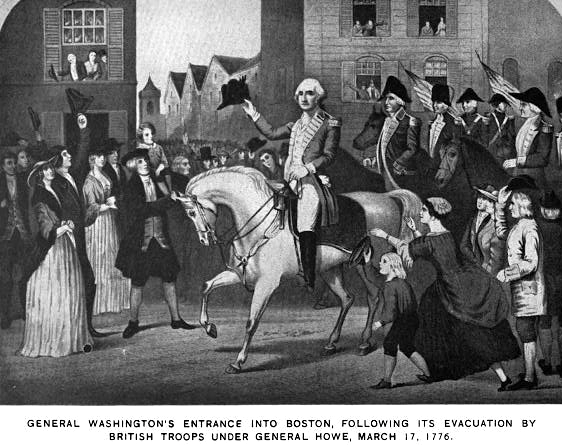
Fanciful depiction of Washington’s triumphal entry into Boston (1916; Wikimedia Commons)
No False Hopes
On March 19, Washington wrote President of the Continental Congress John Hancock, “with the greatest pleasure,” to announce the British evacuation. “I beg leave to congratulate you Sir, & the honorable Congress—on this happy Event,” he wrote, “and particularly as it was effected without endangering the lives & property of the remaining unhappy Inhabitants.”
In fact Washington’s own mood, as he demanded and perused highly detailed reports of the stores and ordnance the British had left behind, was anything but rosy. All along, he had hoped to capture Boston along with its British garrison, inflicting a major defeat and shortening, perhaps ending the war. Instead, the British had escaped, presumably to regroup before launching a new invasion. Victory remained far off.
Refreshed, reinforced, and still determined to crush the rebellion, where would the British go next? Everyone had a different opinion. Washington, trusting his instincts, was never in doubt. “I suppose New York to be the object in view,” he told his friend, Lieutenant Colonel Joseph Reed. With that in mind, the commander-in-chief immediately dispatched his riflemen, and his best infantry regiments, to the southward.
He did so with determination, but no particular confidence. General Charles Lee, sent several weeks earlier to survey and improve New York City’s defenses, suggested that the place was indefensible. Washington suspected Lee was correct.