George Washington @ 250: The Gambler
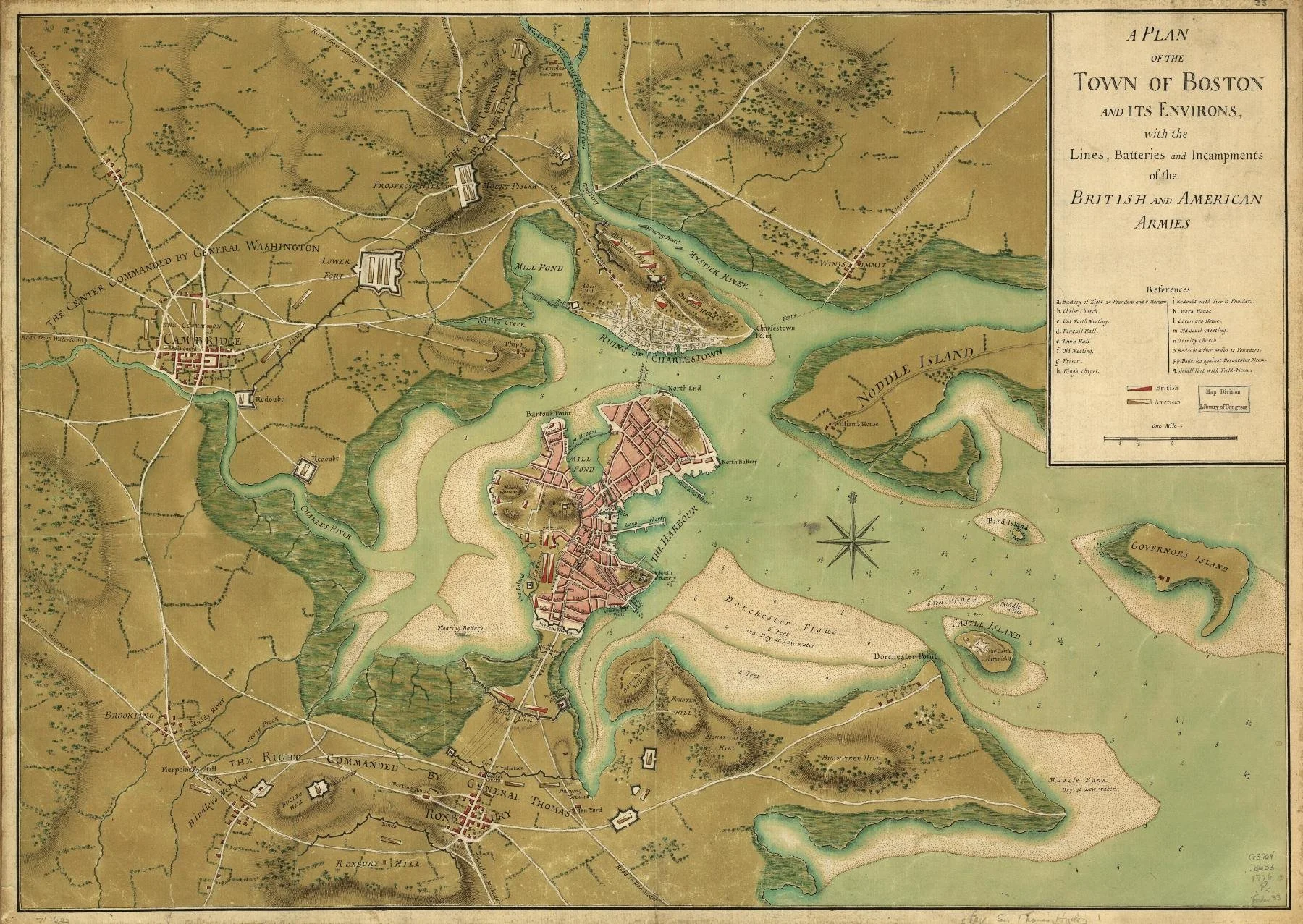
Contemporary Siege Map of Boston (Wiimedia Commons; public domain)
Risk Above Caution
According to legend, George Washington was a Fabian warrior, always prioritizing the preservation of his army, averse to needless risk, and certain that over time that he could outlast the British.
The legend is wrong. Washington was from the beginning, and would always remain, a gambler. In the end, that’s how he won the war. For now, though, we’re considering the events of February 1776, 250 years ago, when the Revolutionary War had hardly begun.
The momentous decision having been made in a February 16, 1776 Council of War, to entrench the army’s artillery on Dorchester Heights, IF enough powder and other equipment could be secured, Washington focused on preparedness. General Orders on February 17 told regimental commanders to ensure that each one of their men had precisely 24 musket cartridges; and quartermasters were told significantly to assemble and prepare entrenching tools. Good news arrived that same day of the arrival in camp at Cambridge, Mass., of a large ammunition convoy from New York.
Far from endorsing the council of war’s decision to reject a frontal assault on the British entrenchments outside Boston, and to consider moving the artillery to the Heights, however, Washington still wasn’t certain his officers had made the right choice. On February 18 he sat down to write a letter to Continental Congress President John Hancock—“not by way of Complaint,” Washington insisted, but still to point out that the cautious path his officers had chosen did not align with his own instincts. Their conclusions “I must suppose to be right,” he conceded; but “from a thorough conviction of the necessity of attempting something against the Ministerial Troops before a Re-inforcement should arrive, and while we were favour’d with the Ice, I was not only ready, but willing and desirous of making the Assault; under a firm hope, if the Men would have stood by me, of a favourable Issue; notwithstanding the Enemy’s advantage of Ground—Artillery—&ca.” The hint was clear—maybe the assault should take place after all? Washington waited three days before actually dispatching this letter to Hancock, but as his frustration mounted, he finally did, on February 21.
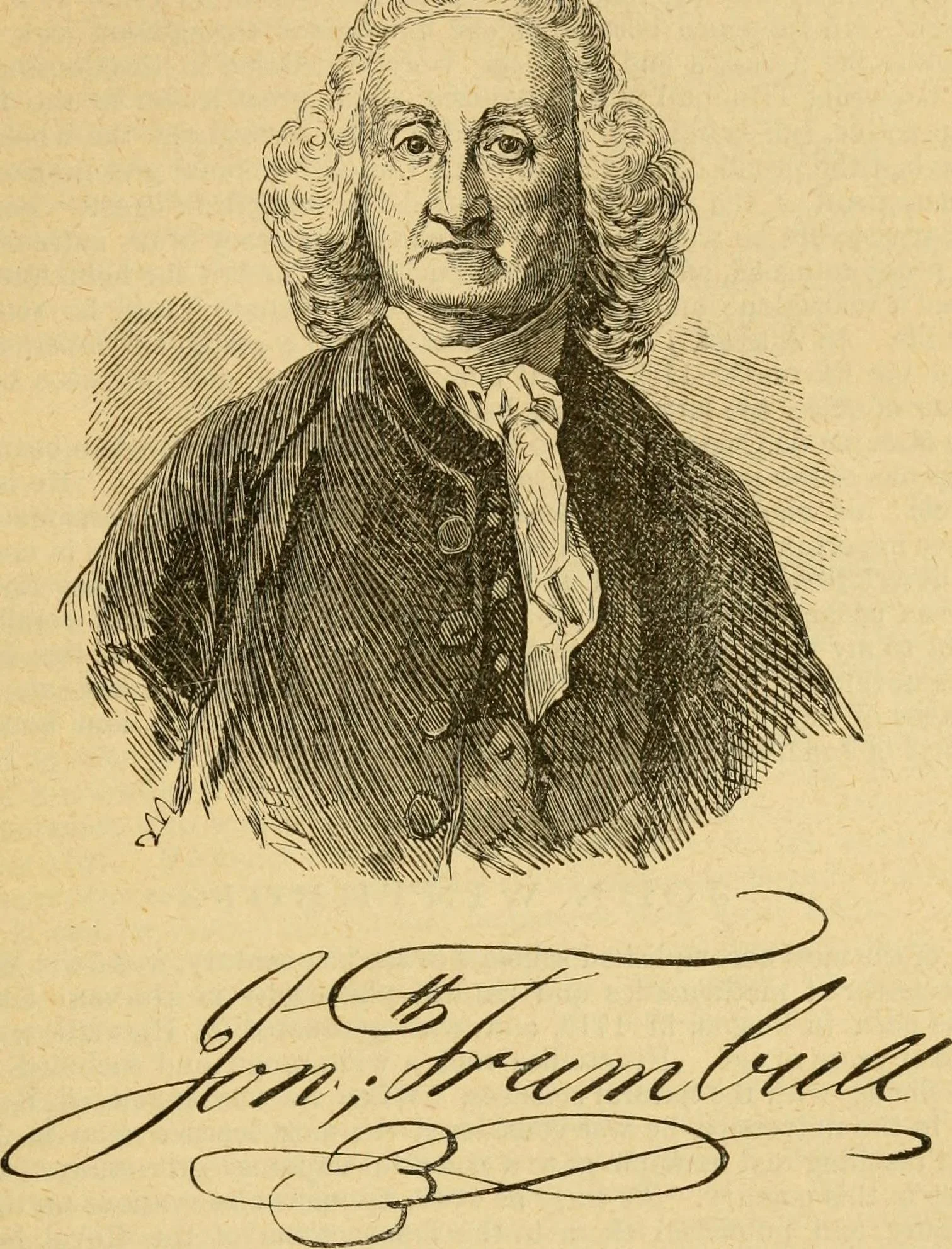
Connecticut Governor Jonathan Trumbull, Sr. (Wikimedia Commons; public domain)
A Reputation Lost Cannot Be Recovered
Sensitivity about his personal reputation heavily influenced Washington’s thought process. Writing on February 19 to Connecticut Governor Jonathan Trumbull, Sr.—once dubious about the Virginian, but now a friend—Washington confessed that “I am so restrained in all my military movements for want of these necessary supplies, that it is impossible to undertake any thing effectual; and while I am fretting at my own disagreeable situation, the world, I suppose, is not behind hand in censuring my inactivity.” Once again, as he had done with Hancock, Washington explained his own plan to attack Boston, suggesting it might have succeeded; and while conceding that his council of war had decided otherwise, “perhaps rightly,” he wanted Trumbull to know that the cautious path had been against his own inclinations.
Washington wrote to Trumbull, he specified, “in confidence”; but it’s certain he wanted everyone to know, lest posterity should judge him severely, that his officers had blocked an opportunity to seize Boston and maybe end the war. Again, Washington begged Trumbull and everyone else for powder—powder!—but his manner makes it clear that Washington feared he would never have enough, and stagnation would result. New York’s Provincial Congress informed him regretfully that they had none to share; and Trumbull’s Connecticut, a primary source of that essential item, also fell short.
As February 1776 approached its end, then, there were no celebratory fist bumps or smirks of anticipation at Washington’s headquarters. The war, he very much feared, might already be lost. Worse, from his perspective: he would be blamed., and his reputation would never recover.