Palace or People’s House? Founders’ Intent for the White House, Part II: A Public Competition
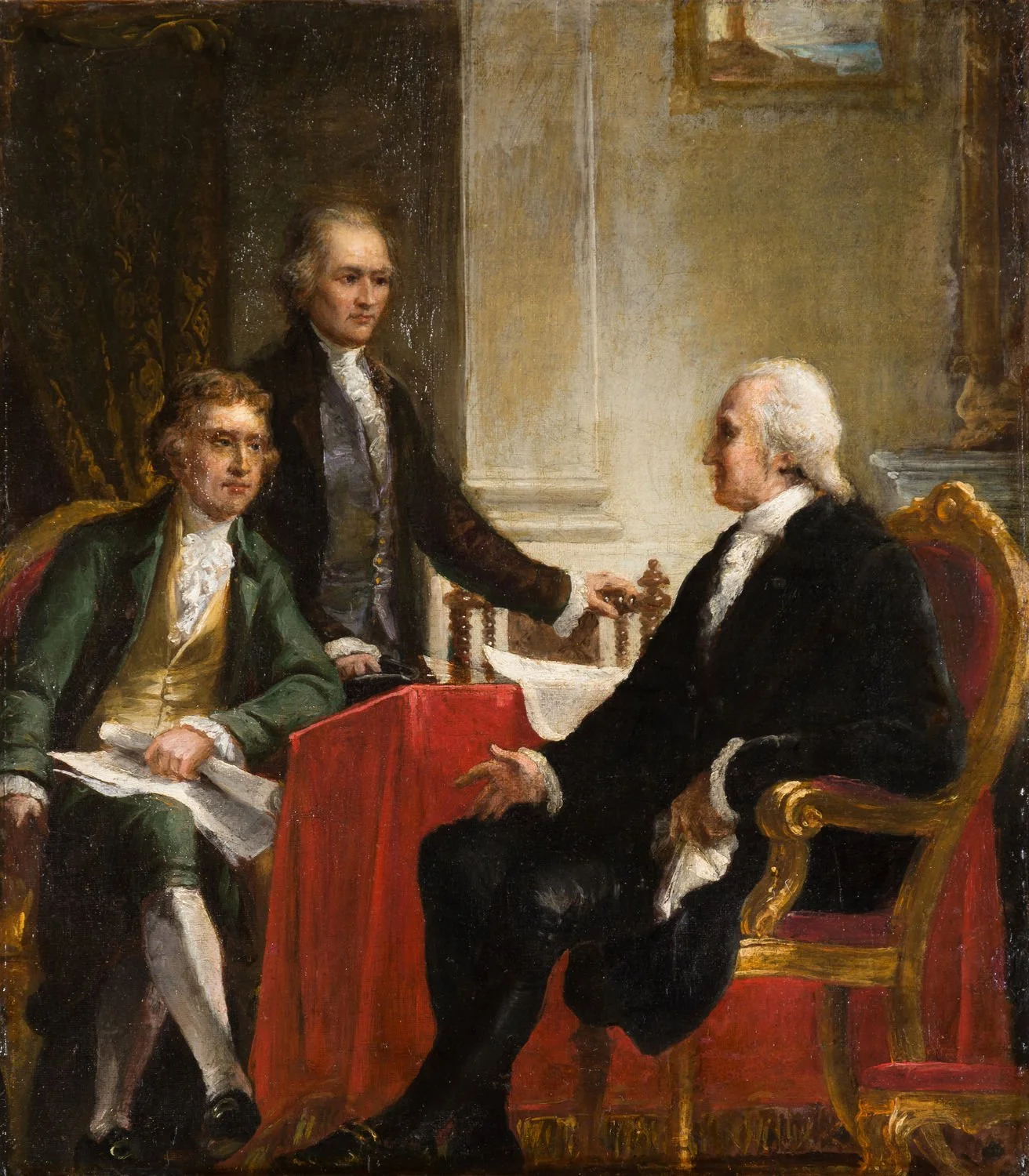
George Washington, Thomas Jefferson and Alexander Hamilton, by Constantino Brumidi (US Senate Collection)
Great Men, Political Rivals
President George Washington and Secretary of State Thomas Jefferson were the two individuals most deeply involved in the conception and design of what would become the White House. Their political outlooks were different, and became more pronounced over time.
Washington had of course achieved fame as a soldier, leading the Continental Army to victory during the Revolutionary War. He also was a farmer-entrepreneur of no mean ability. A consensus-builder, he had presided over the Constitutional Convention; and on taking up the presidency in 1789 he had stated that building the national prosperity should be his first and only aim. Although he had fought and defeated the British Empire, and believed in liberty, Washington respected, even admired, the British political system—not for its monarchy so much as for its balanced view of human liberty, the rule of law, and entrepreneurship (the Industrial Revolution was just underway there)—all rooted in a classical republican tradition. King George III and power-hungry men in Parliament had, he believed, tried and failed to usurp this balance; but Great Britain was, Washington believed, still the United States’ best partner and model for the future, offering moral and political examples that Americans should emulate.
Jefferson, by contrast, was a civilian through and through; a sharp (and often ruthless) politician; an intellectual; and a man of complex and fervently held political beliefs. While Washington, like British political philosopher Edmund Burke, cautiously approved of the early stages of the French Revolution that began in 1789 and the creation of a constitutional monarchy, Jefferson didn’t think the French Revolution went far enough. When the French Revolution entered a far more radical phase in 1792, King Louis XVI was executed, and political violence began ramping up, Jefferson could barely conceal his delight. Anything smacking of aristocracy and monarchy—even constitutional monarchy—he believed, should be eradicated.
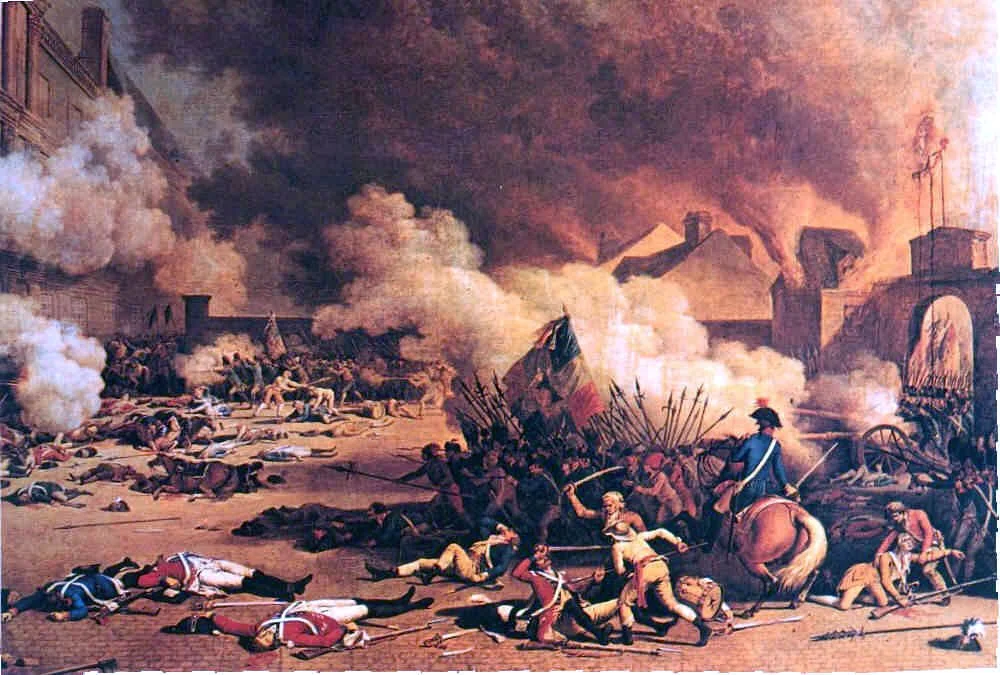
Storming the Tuileries, Aug. 1792, French Revolution, by Jacques Bertaux (Palace of Versailles)
A House, Not A Palace
Still, Jefferson was a Francophile, and he admired French culture, art, and architecture, even that predating the Revolution. In April 1791, when Pierre L’Enfant was designing what he often called a palace for the President of the United States in the new Federal City—to become Washington, D.C.—Jefferson (albeit calling the place a house instead of a palace), wrote to the Frenchman that, “for the President’s house I should prefer the celebrated fronts of Modern buildings which have already received the approbation of all good judges. Such are the Galerie du Louvre, the Gardes meubles, and two fronts of the Hotel de Salm.”
By the end of that year, however, Jefferson had soured on L’Enfant, and also moderated his own views of the president’s house. Not only should it become a more modest gentleman’s home, Jefferson believed, but it should be built of humble brick instead of cut stone. After L’Enfant’s departure in early 1792, Jefferson attempted to dominate planning for the building, and succeeded to the point that henceforth everyone, including Washington, now called it a house instead of a palace
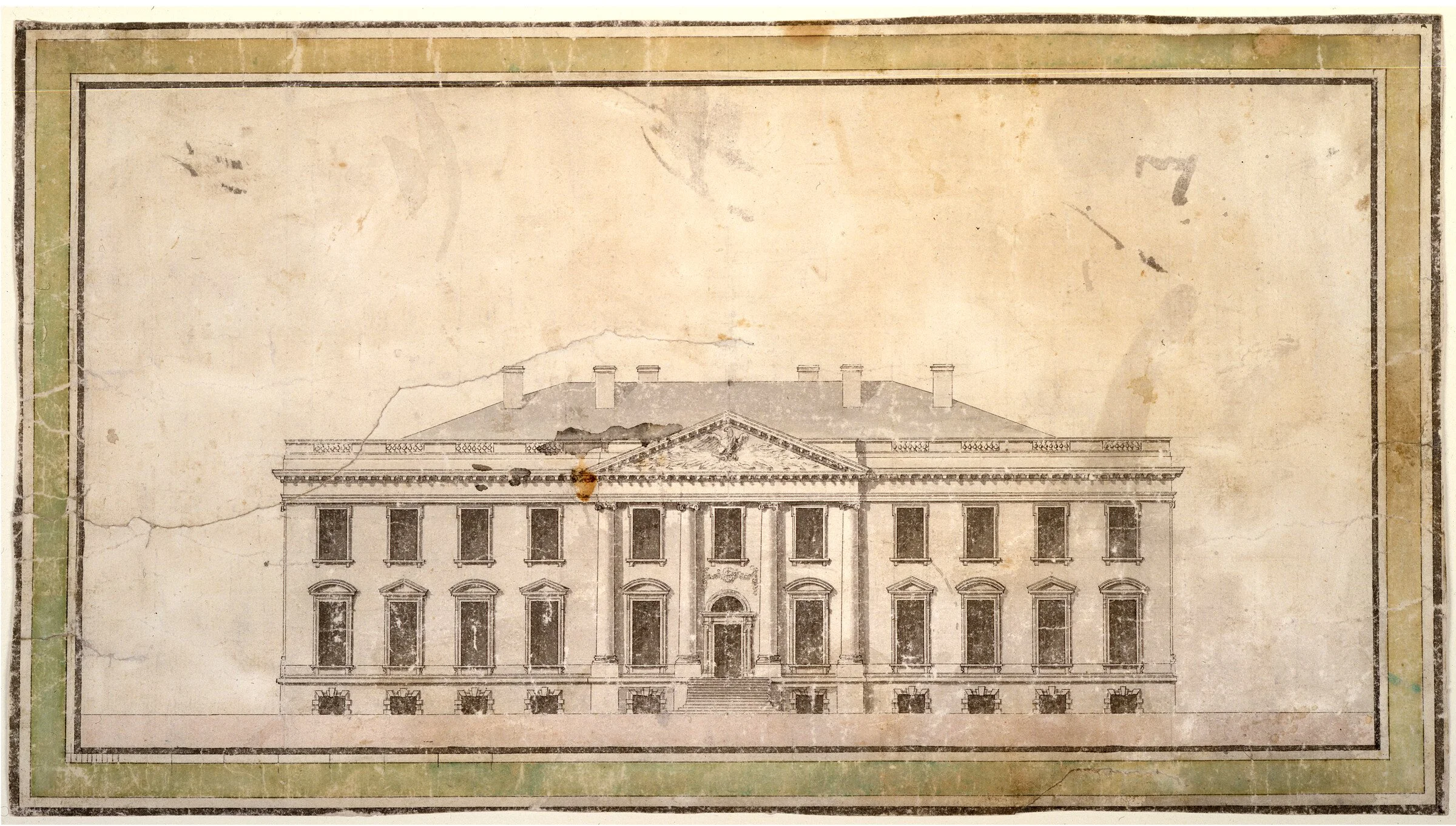
James Hoban, 1793 President’s House Design (Maryland Historical Society)
Public Competition, Public Ownership
By the spring of 1792, political divisions in the United States were rapidly deepening. Disgusted by increasing factionalism, Washington had no intention of seeking a second term as president; but in the meantime, he had no desire to go to war with Jefferson and other political radicals, although he abhorred many of their ideas. Although he had given preliminary approval to L’Enfant’s now-defunct idea for a presidential “palace,” and still believed the place should be constructed of cut stone instead of brick, therefore, Washington deferred in March 1792 to Jefferson’s request for a public competition to design the president’s house. Jefferson’s proposed advertisement for the competition, submitted to Washington and the Commissioners for the Federal District, was generally vague, but implied that the building should be economical and not too ostentatious, and specified that it should be a “house,” and made of “brickwork.”
Implicit in this decision to open a public competition was the belief that the president’s house ultimately belonged to the people, and must reflect a consensus of American political ideals in keeping with the still-young Constitution and Federal government. That consensus was increasingly fragile; but Jefferson and Washington agreed that somehow, it must be preserved. There was no thought of a design for this building being imposed from above, by a president focused on his own inclinations and desires—even with the mandate of unanimous election. The president’s house must not become a bone of political contention, but must rise above partisanship.
Commenting on the designs submitted in this competition, White House historian William Seale noted that, “They are reminiscent of town halls, statehouses, even—except for their large scale—the houses of provincial mayors or bishops in Europe. [They] provide a rare glimpse of the widespread uncertainty over what form the architectural trappings of the Presidency should take. Palaces, of course, were obvious models, and illustrations of these were commonly available in books. But the competition had reservations about anything smacking of royalty.”
The competition’s eventual winner, as we’ll see, was an Irishman—James Hoban—whose design captured the ideals of virtuous republican government that Washington and Jefferson shared, despite their deep political differences.