Palace or People’s House? Founders’ Intent for the White House, Part III: James Hoban in an Era of Conflict
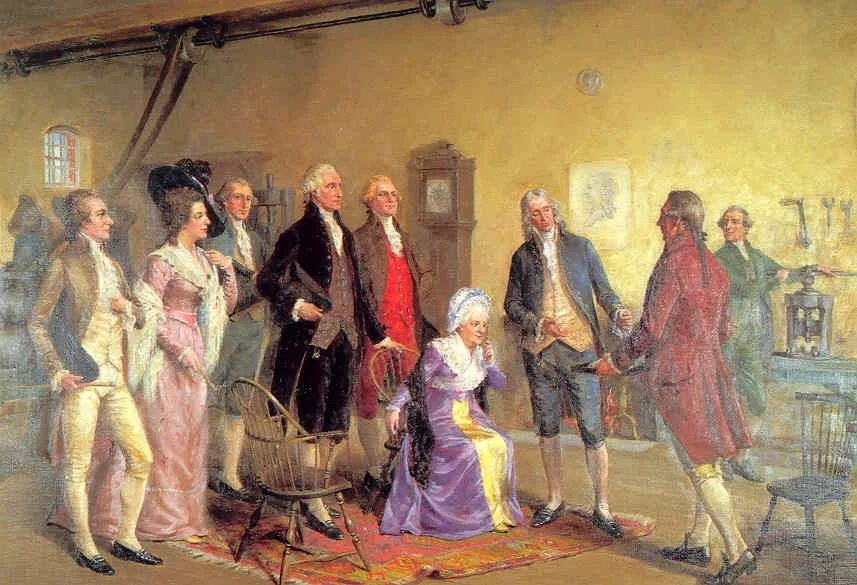
America’s First Coins, July 13, 1792 (John Ward Dunsmore; Wikimedia Commons
A Fractured Nation
Irish architect James Hoban won the competition for designing the president’s house on July 17, 1792—just four days after the presentation of the first coins at the U.S. Mint as depicted above by artist John Ward Dunsmore (Alexander Hamilton and Thomas Jefferson notably appear on opposite sides of President George Washington).
Before considering how Hoban and Washington proceeded to design and construct the president’s house, it’s essential to consider the dangerously fractured era in which they set to work.
By the summer of 1792, Washington was approaching the end of his first term as president of the United States. He had no aspiration for seeking another. Since 1789, his intent had been to establish the foundations of a stable government, with well-functioning institutions and, in particular, a solid foundation for economic growth. These, with Secretary of the Treasury Hamilton, and Secretary of State Jefferson, Washington considered that he had achieved.
Now, though, Hamilton and Jefferson, with their followers and allies, were at loggerheads—dangerously so. Their visions of the future of the United States, at home and in the world, differed fundamentally, with Hamilton looking toward longstanding, especially British, political traditions; and Jefferson much in sympathy with the French Revolution, even as it entered a radical, violent phase—The Terror—in 1792.
Washington tried to effect a truce, but without success, as the rivalry between Hamilton and Jefferson transitioned to outright hatred; to the point that many feared civil war. “How unfortunate, and how much is it to be regretted then,” Washington complained, “that whilst we are encompassed on all sides with avowed enemies & insidious friends, that internal dissentions should be harrowing & tearing our vitals.”
Disgusted and tired, Washington determined to return to Mount Vernon. Not until November 15, 1792, when his close friend Elizabeth Willing Powel implored him to sacrifice his happiness by accepting one more term as president, did he agree to do so—but only in the belief that his primary purpose was to prevent political zealotry, and possible foreign war, from tearing the nation apart.
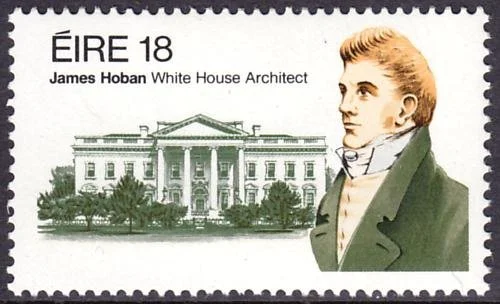
James Hoban postage stamp, Ireland 1981
James Hoban’s Arrival
Born in County Kilkenny, Ireland, James Hoban had arrived in the United States in 1787, and designed the Charleston County Courthouse. Washington apparently met him during his own tour to the south, which included South Carolina, in 1791. He did not remember him well in 1792, however, and gave no special preference to Hoban, who won the prize on his own merits (albeit not against much competition).
Writing to the Commissioners for the District of Columbia on July 23, the president expressed his belief that if Hoban’s “industry and honesty are of a piece with the specimen he has given of his abilities, he will prove a useful man & a considerable acquisition.” The relationship between Washington and Hoban would remain a professional one; they exchanged very little direct correspondence, and there is no evidence that they became close associates, let alone friends.
So far as Washington’s sense of his own role in the presidential mansion’s design—knowing that he would never live there—he took a strong, but far from a personal interest in the place. And he was conscious of both his own preferences, and his shortcomings. In the same letter to the commissioners, he specified that the building should: “not be too expensive for our means, [but nevertheless] a noble & desireable Structure. But, I would have it understood in this instance, and always, when I am hazarding a sentiment on these buildings, that I profess to have no knowledge in Architecture, and think we should (to avoid criticisms) be governed by the established Rules which are laid down by the professors of this Art.” He would, in other words, defer to the professionals, instead of demanding that they dance to his imperious tune.
By the beginning of 1793, Jefferson—an architect with decided views on how the president’s house should be built; namely, that it should be a humble brick edifice—was on his way out of government, declaring to Washington that he would retire to Monticello and mind his own business henceforth.
In theory, then, Washington could ignore Jefferson’s desires—and push, if he so wished, for the construction of a palatial edifice. One of his first directions, in fact, was that Hoban should design a building of cut stone instead of brick. Still, Jefferson’s ghost very much lingered; and Washington was unsurprised when the Master of Monticello quickly began meddling in national political affairs from behind the scenes.
As he moved forward to work with Hoban, the Commissioners, and others to design the president’s house, then, Washington would tread extremely carefully. Whatever else, the mansion must not become a venue for partisan conflict.
We’ll trace how that developed in Part IV of Palace or People’s House: Founders’ Intent for the White House.